



Summary (as of 27.10.2026)
S3 safety shoes belong to protection class S3 of EN ISO 20345 and have a toe cap, a closed heel area, antistatic properties, energy absorption in the heel area, protection against water penetration and water absorption, puncture resistance with a metal insert and a treaded sole. Metal-free inserts are marked as S3L or S3S, fully waterproof shoes as S7. Which class a company needs is determined by the risk assessment.
On the tongue, sole or box of safety shoes is an abbreviation such as S1, S2 or S3. Behind it is no brand promise, but a standardized level of protection according to EN ISO 20345. Those who know the meaning of S3 buy neither too little protection nor properties that the workplace does not need at all.
This guide explains which requirements S3 covers according to the current state of the standard, what changed with the 2022 revision, how S3 differs from S1, S2, S3L, S3S and S7 and how companies select the appropriate class.
What does S3 mean for safety shoes?
S3 is one of the short designations with which EN ISO 20345 summarizes frequently used combinations of requirements. According to the DGUV PPE specialist department (foot protection area), the following applies for the 2022 edition: S3 corresponds to S2 and additionally offers resistance to puncture with a metal insert (Type P) as well as a treaded sole. S2 in turn corresponds to S1 plus protection against water penetration and water absorption. All safety shoes have a toe cap in common.
An S3 shoe thus covers the following requirements:
- Closed heel area: The heel is enclosed, the shoe is not an open clog.
- Antistatic properties (A): Electrostatic charges are controlled and dissipated.
- Energy absorption capacity in the heel area (E): The heel dampens impacts when walking.
- Water penetration and water absorption (WPA): The material is tested for moisture, but the shoe is not completely waterproof.
- Puncture resistance (Type P): A metal insert protects the sole against sharp objects from below.
- Treaded sole: The outsole is treaded.
- Slip resistance: According to the 2022 edition, testing on ceramic tiles with a sodium lauryl sulfate (NaLS) solution is a basic requirement for every safety shoe.
The following overview shows how the classes build on each other:
| Short designation | Requirements |
|---|---|
| S1 | Closed heel area, antistatic properties, energy absorption in the heel area |
| S2 | Like S1, additionally water penetration and water absorption (WPA) |
| S3 | Like S2, additionally resistance to puncture with a metal insert (Type P) and a treaded sole |
| S3L, S3S | Like S3, but with a non-metallic insert (Type PL or PS) |
| S6 | Like S2, additionally waterproof in the assembled state (WR) |
| S7 | Like S3, additionally waterproof in the assembled state (WR) |
| S7L, S7S | Like S3L or S3S, additionally waterproof in the assembled state (WR) |
Designations with P, such as S1P, combine puncture resistance with the properties of S1. The selection in the shop ranges from S1 and S1P to S2 to S3.
What changed with EN ISO 20345:2022?
The standard was revised in 2022. According to DIN Media, DIN EN ISO 20345:2024-06 (EN ISO 20345:2022 + A1:2024) currently applies, which replaces the 2022-06 edition. For the meaning of S3, the following changes are important:
- Puncture resistance in three types: P stands for the metal insert, PL and PS for non-metallic inserts. According to manufacturer specifications for the standard, P and PL are tested with a test nail of 4.5 mm diameter, PS with 3.0 mm.
- Slip resistance: Testing on ceramic tiles with NaLS is a basic requirement. An optional test on ceramic tiles with glycerin is marked with SR. The symbols SRA, SRB and SRC belong to the standards from 2011 and 2012.
- Water protection: WRU was replaced by WPA.
- Fuel resistance: In the 2011 edition, it belonged to the categories S1 to S3. In the DGUV overview for 2022, it is no longer in the categories, but FO remains as an additional symbol.
- New categories and symbols: S6 and S7 for waterproof shoes as well as the symbols LG (Hold on ladders) and SC (Overcap abrasion).
- Expiration date: The standard adds information about this.
Shoes according to the standards from 2011 and 2012 still bear the old markings. Therefore, the marking on the delivered pair and in the manufacturer's product information is always decisive.
What do S3L, S3S and S7 mean?
The addition behind S3 reveals the type of puncture resistance. S3 without addition means a metal insert (Type P). S3L and S3S have a non-metallic insert of Type PL or PS. The scope of protection of class S3 remains the same, the inserts differ in material and test nail. Whether a metal-free insert is advantageous for use, for example due to weight or flexibility, companies clarify using the product information.
S7, S7L and S7S correspond to S3, S3L and S3S, additionally the entire shoe must be waterproof in the assembled state (WR). In contrast, with S3 only water penetration and water absorption are tested. Therefore, those who work permanently in wet conditions should look for WR or S7.
Which additional symbols are there next to S3?
In addition to the category, safety shoes carry further symbols for properties that go beyond the category. The most important for S3 shoes:
| Symbol | Meaning |
|---|---|
| SR | Slip resistance on ceramic tiles with glycerin (2022 standard) |
| WR | Water resistance of the shoe |
| HRO | Behavior towards contact heat |
| FO | Fuel resistance |
| HI, CI | Thermal insulation or cold insulation of the sole assembly |
| AN | Ankle protection |
| CR | Cut resistance |
| M | Midfoot protection |
| LG | Hold on ladders (2022 standard) |
| SC | Overcap abrasion (2022 standard) |
Check these symbols before purchase. When working on ladders, on hot surfaces or in the cold, they often determine whether an S3 shoe is suitable for use. Further abbreviations from A to Z are explained in the PPE lexicon.
When is S1, S1P or S2 sufficient, when is S3 needed?
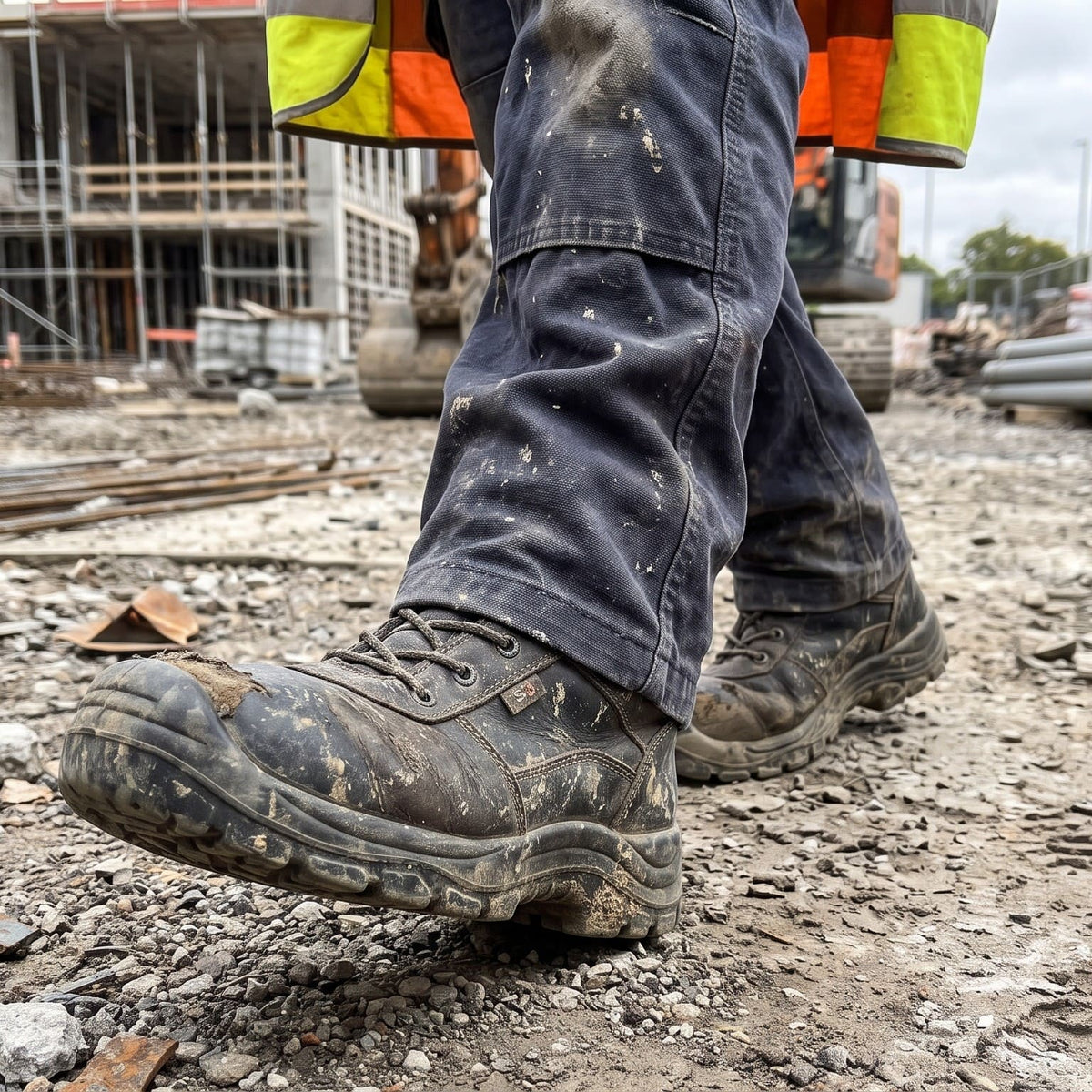
Our classification from the definitions of the classes: S1 covers dry environments without puncture hazard, S1P adds puncture protection. S2 adds protection against water penetration and water absorption compared to S1. S3 combines both and is suitable when moisture and sharp objects meet on the ground. Typical places of use for S3 safety shoes are construction sites in high-rise and civil engineering as well as gardening and landscaping.
You can find suitable ranges for road construction and for gardening and landscaping. S3 is not blanket better than S1P or S2. The class covers other risks, and every additional property has an impact on weight and comfort. The decisive factor is that the class fits the hazard at the workplace.
S3 or S5: What applies to rubber and polymer boots?
The standards distinguish two classifications. Class I includes shoes made of leather or other materials according to conventional shoe manufacturing, where S1 to S3 as well as S6 and S7 apply. Class II includes fully formed or vulcanized shoes, i.e. rubber and polymer boots. S4 and S5 apply to them: S4 offers antistatic properties and energy absorption in the heel area, S5 adds puncture resistance and a treaded sole. For wet areas, you can find rubber boots and waders in the range.
How do companies select the appropriate class?
Which class is necessary is not decided by purchasing, but by the risk assessment. You can find the background to this in our post What is the difference between occupational health and safety?. As personal protective equipment, safety shoes fall under Regulation (EU) 2016/425. According to EUR-Lex, proof of the requirements is provided by the CE marking on the product.
Help with the selection is provided by DGUV Rule 112-191 "Use of foot and knee protection", which was published in a new edition in December 2025. It defines wear features and damage that exclude safe use (end of service life), gives recommendations for selected work areas and contains sample operating instructions. An activity-related example list also lists the DGUV foot protection area. In case of doubt, clarify the classification with your occupational safety specialist.
Checklist for the procurement of S3 safety shoes:
- Hazard defined according to the risk assessment (wetness, sharp objects, cold, heat, ladders)
- Category selected appropriately (S1, S1P, S2, S3, S3L, S3S or S7)
- Marking according to EN ISO 20345 with year of edition and CE marking present on the shoe
- Additional symbols checked appropriate for use (SR, WR, HRO, LG, CI)
- Puncture resistance understood: Type P (metal) or PL and PS (non-metallic)
- Fit tested, manufacturer's instructions on care and replacement observed
What do you look for when wearing and when do you replace?
A safety shoe only protects if it fits and is undamaged. Size charts provide guidance on the size, for example for Elten shoes or Cofra shoes. Suitable socks and accessories complement the shoe. Replace safety shoes, among other things, if the toe cap is damaged or deformed, the sole is heavily worn or coming loose, the upper material has cracks or the shoe no longer fits securely. The binding criteria for end of service life are stated in DGUV Rule 112-191.
S3 safety shoes at Technigro
At Technigro you will find S3 safety shoes in many brands and shoe styles, as well as the other classes from S1 to S7. For companies there is a B2B program with a company account. Read further background in the posts Safety shoes: what really matters when buying and Choosing PPE correctly: what lies behind the standards.
Those who procure S3 safety shoes determine the class based on the risk assessment and check the marking, year of edition and additional symbols on the delivered pair.
Note: This post provides general information (as of 27.10.2026). Which protective equipment is required is determined by the risk assessment of your company. In case of doubt, clarify the selection with your occupational safety specialist.
Sources
- DGUV, PPE specialist department, foot protection area: What requirements do the short designations include? (Standards 2011, 2012 and 2022). Accessed on 27.10.2026.
- DIN Media: DIN EN ISO 20345:2024-06, Personal protective equipment – Safety shoes (EN ISO 20345:2022 + A1:2024), current status. Accessed on 27.10.2026.
- DIN Media: DIN EN ISO 20345:2022-06, withdrawn, with overview of changes (including S6 and S7, expiration date). Accessed on 27.10.2026.
- Sievi: Safety shoe standard EN ISO 20345:2022, manufacturer information on the test nails of the puncture types. Accessed on 27.10.2026.
- DGUV: DGUV Rule 112-191 Use of foot and knee protection, December 2025 edition. Accessed on 27.10.2026.
- DGUV: Example list of foot protection for selected activities (2022 standard series). Accessed on 27.10.2026.
- EUR-Lex: Summary of Regulation (EU) 2016/425 on Personal Protective Equipment. Accessed on 27.10.2026.


