



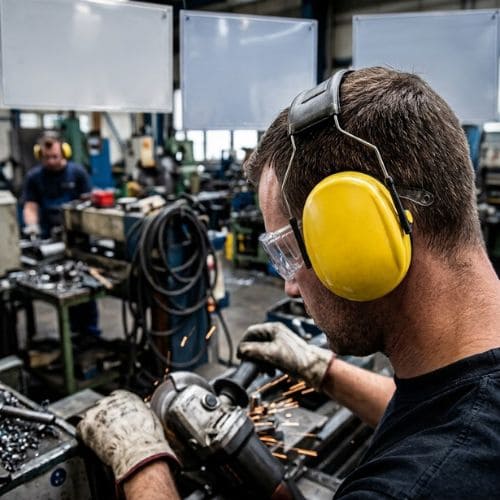
Summary (as of 27.10.2026)
For a daily noise exposure level of 80 dB(A) or more, companies must provide hearing protection; from 85 dB(A), it must be worn. The attenuation is suitable if 70 to 80 dB(A) reach the ear under the hearing protection; over 85 dB(A) is not permitted. The hearing protection dB table in this guide shows trigger values, assessment of the residual level, and a calculation example with the SNR value and practical deduction according to DGUV Rule 112-194.
Noise gradually damages hearing. Those who are surrounded by loud machines, tools, or vehicles every day often only notice the consequences when they can no longer be undone. Hearing protection is therefore mandatory in many companies. But how much attenuation is necessary? Too little does not provide sufficient protection, while too much isolates so strongly that warning signals and conversations are lost.
This guide explains using tables when hearing protection is mandatory, what level should reach the ear under the hearing protection, how to calculate with the SNR value and practical deductions, and what companies should pay attention to when selecting.
When is hearing protection mandatory?
The Noise and Vibration Occupational Safety Ordinance (LärmVibrationsArbSchV) specifies two levels of trigger values in Section 6. When applying the trigger values, the attenuating effect of the hearing protection is not taken into account. Therefore, the noise at the workplace is decisive, not the level under the hearing protection.
| Trigger value | Daily noise exposure level | Peak sound pressure level | Company obligation |
|---|---|---|---|
| Lower trigger values | 80 dB(A) | 135 dB(C) | Provide suitable hearing protection |
| Upper trigger values | 85 dB(A) | 137 dB(C) | Ensure the use of hearing protection, mark noise areas with the mandatory sign M 03 |
The daily noise exposure level refers to an eight-hour shift and includes all noise events at the workplace. The noise assessment during the risk assessment determines which values apply to you. Technical and organizational measures take precedence over personal hearing protection.
How many dB of attenuation do I need? The hearing protection dB table for the residual level
There is no universal figure. What matters is the level that reaches the ear under the hearing protection, the residual level. The DGUV assesses it according to the following scheme:
| Residual level at the ear | Residual peak level at the ear | Assessment |
|---|---|---|
| Over 85 dB(A) | Over 137 dB(C) | Not permitted |
| Over 80 dB(A) | Over 135 dB(C) | Not recommended |
| 70 to 80 dB(A) | Up to 135 dB(C) | Recommended |
| Under 70 dB(A) | No value | Check communication and sense of isolation |
The DGUV calls excessive attenuation overprotection. It occurs when warning signals or machine noises can no longer be heard safely, speech intelligibility suffers, or a sense of isolation arises. This is not just a comfort issue: overprotection often places a mental strain on employees according to the DGUV.
How do you calculate with the SNR value?
On hearing protection, you will find the SNR value, a single-number value of the attenuation. It is subtracted from the C-weighted level at the workplace. Important: The SNR and HML values of the manufacturers do not include the practical deductions. DGUV Rule 112-194 (September 2024 edition) specifies them depending on the hearing protection type, because the protective effect in practice is lower than in the laboratory due to improper use or wear.
| Hearing protection type | Practical deduction |
|---|---|
| Hearing protection plugs to be shaped before use | 9 dB |
| Pre-formed hearing protection plugs | 5 dB |
| Armband plugs | 5 dB |
| Cup hearing protection | 5 dB |
| Hearing protection earplugs with function control | 3 dB |
Calculation method: Residual level at the ear = C-weighted level at the workplace minus SNR plus practical deduction. Example: The workplace has 100 dB(C), the cup hearing protection has SNR 30. Then 100 minus 30 plus 5 equals 75 dB(A), which is in the recommended range. The following hearing protection dB table shows residual levels for cup hearing protection with a practical deduction of 5 dB. Bold values are in the recommended range of 70 to 80 dB(A).
| Level at the workplace | SNR 20 | SNR 25 | SNR 30 | SNR 35 |
|---|---|---|---|---|
| 90 dB(C) | 75 dB(A) | 70 dB(A) | 65 dB(A) | 60 dB(A) |
| 95 dB(C) | 80 dB(A) | 75 dB(A) | 70 dB(A) | 65 dB(A) |
| 100 dB(C) | 85 dB(A) | 80 dB(A) | 75 dB(A) | 70 dB(A) |
| 105 dB(C) | 90 dB(A) | 85 dB(A) | 80 dB(A) | 75 dB(A) |
| 110 dB(C) | 95 dB(A) | 90 dB(A) | 85 dB(A) | 80 dB(A) |
Values over 85 dB(A) are not permitted, values over 80 dB(A) are not recommended. With foam plugs to be shaped before use, the residual level increases by a further 4 dB due to the deduction of 9 dB. The table is a calculation example and does not replace selection according to DGUV Rule 112-194. Further abbreviations such as SNR, HML, or SR are explained in the PPE Lexicon.
For a more precise selection, especially for low-frequency noise such as from motors or compressors, use the H, M, and L values. According to the DGUV, the M value applies in the high and mid-frequency range (difference between C and A levels up to 5 dB), the L value for low-frequency noise (difference over 5 dB), each in the HML check according to DIN EN 458.
Why the duration of wear determines the attenuation
Even high-quality hearing protection only helps if it is worn at all times. The DGUV calculates in its prevention guideline according to DIN EN 458: For continuous noise of 105 dB and hearing protection with 30 dB attenuation, the effective level when worn continuously is 75 dB. If it is removed for only 30 minutes in a shift, it rises to 93 dB. If it is worn for only four hours in an eight-hour shift, an effective protective effect of only 3 dB remains.
In practice, this means: Plan breaks and changes so that hearing protection does not have to be removed in noise areas, and choose a model that employees like to wear all day.
What types of hearing protection are there?
The DIN EN 352 standard series regulates hearing protection. Part 1 applies to cup hearing protection, Part 2 to hearing protection plugs, Part 3 to cups attached to head protection (edition 2020 according to DGUV Rule 112-194). The DGUV distinguishes three types:
- Cup hearing protection: with head, neck, or universal headband, as a variant attached to the safety helmet, as well as with level-dependent attenuation, communication device, or active noise compensation.
- Hearing protection plugs: for single or multiple use, pre-formed or to be shaped before use, also as armband plugs, with connection cord or detectable, for example for the food industry.
- Custom earplugs: plugs individually made for the individual ear canal from hard material or silicone.
In addition to attenuation, continuous or repeated short-term noise, peak levels, warning signals, speech intelligibility, temperature, humidity, dust, and the combination with other protective equipment are considered. When combined with a helmet, according to DGUV Rule 112-194, cup hearing protection attached to the industrial safety helmet is often used, which may only be used with the helmet types mentioned in the user information. You can find suitable models in the Safety Helmets and in the Head Protection area. When wearing safety glasses at the same time, the glasses temples should be as flat as possible so that the cup sits tightly. You can find a selection in the Temple Glasses. Electronic hearing protection with communication is tested according to EN 352-6 or -9, models for listening to music according to EN 352-8 or -10 are limited to 82 dB(A).
Qualified use: When do the practical deductions fall away?
If the instruction on the use of hearing protection is carried out at least four times a year with practical exercises and documented, the DGUV rules speak of qualified use. In this case, the practical deductions can fall away, the exposure limit shifts to higher levels. For extremely high sound pressure levels, qualified use is required, from a daily noise exposure level of 110 dB(A) according to TRLV Noise Part 3 it is even mandatory. The exercises include, among other things, the shaping and insertion of foam plugs and the influence of glasses on the tightness of cups.
Wear, maintain, and replace correctly
- Insert foam plugs to be shaped before use according to the manufacturer's information and hold them until they have expanded.
- Pay attention to a tight fit with cups: hair, glasses temples, and helmet straps must not interrupt the seal.
- Replace sealing cushions if they have changed their shape or show cracks and breaks.
- Check hearing protection regularly for deformation, aging, and hardening. Hardened plugs may no longer expand fully in the ear canal.
- Clean according to the manufacturer's instructions, because frequent cleaning can change the material and reduce the attenuation.
- Instruct the employees before the first use and at least once a year thereafter.
The DGUV also recommends wearing trials with a small group before a model is procured company-wide. This way, dust, heat, movement, and signal hearing are shown in practice.
Checklist for procuring hearing protection
- Noise at the workplace determined (daily noise exposure level, peak level, C-weighted level)
- Target residual level of 70 to 80 dB(A) at the ear set
- SNR or H, M, and L value of the hearing protection checked and calculated with practical deduction
- Hearing protection type chosen suitable for duration of wear, temperature, dust, helmet, and glasses
- CE marking and marking according to DIN EN 352 present on the product or on the smallest packaging
- Warning signals and speech intelligibility checked in the wearing trial
- Instruction planned, operating instructions created
Hearing protection at Technigro
At Technigro, you will find hearing protection in the form of earmuffs and earplugs, suitable for safety helmets and safety glasses. Companies order via the B2B program using a corporate account. For more background information, read the posts Choosing the right PPE: what lies behind the standards, Head protection for construction workers: helmet types, EN 397 and selection and What is the difference between occupational health and safety?.
Note: This post provides general information (as of October 27, 2026). The required protective equipment is determined by your company's risk assessment. If in doubt, clarify the selection with your occupational safety specialist.
Sources
- Federal Office of Justice: Section 6 Exposure limits for noise, Noise and Vibration Protection at Work Ordinance (LärmVibrationsArbSchV). Accessed on October 27, 2026.
- DGUV, Specialist Committee on Personal Protective Equipment: General prevention guideline "Hearing protection" (December 2009), with reference to DIN EN 352 and DIN EN 458. Accessed on October 27, 2026.
- DGUV: DGUV Rule 112-194 "Use of hearing protection", edition September 2024. Accessed on October 27, 2026.
- DGUV Rule 112-194, Annex 12: Hearing protectors with EU type-examination certificate, practical deductions and areas of use (list current as of June 25, 2024). Accessed on October 27, 2026.
- DGUV Rule 112-194, Annex 10: Regulations and rules, standards DIN EN 352 Parts 1 to 3 (2020 edition). Accessed on October 27, 2026.
- DGUV Rule 112-194, Chapter 3: General principles, PPE Regulation, Regulation (EU) 2016/425 and marking. Accessed on October 27, 2026.


