



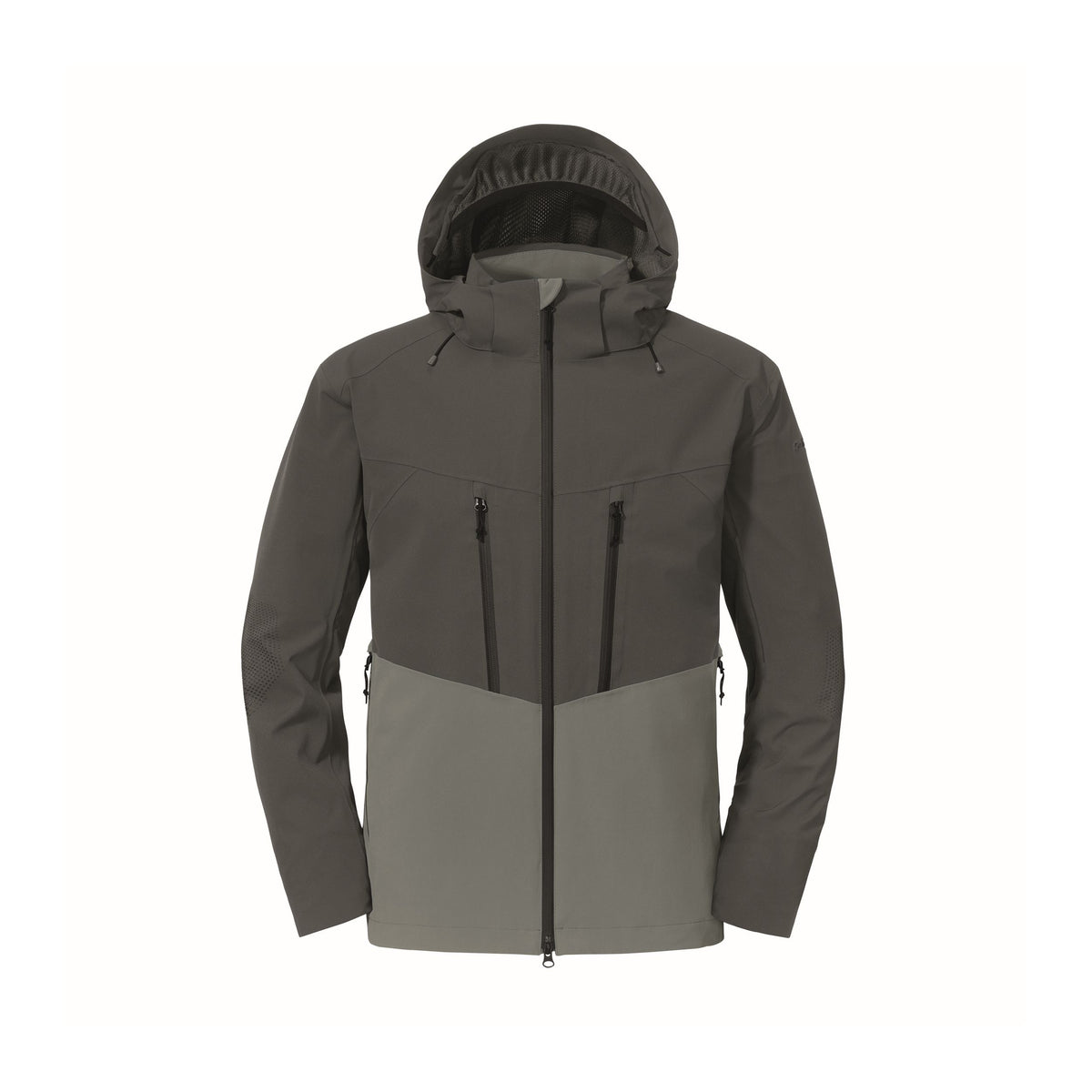


Work jackets: How to properly combine weather protection, warmth and visibility
A work jacket must do more than a leisure jacket: it protects in rain and wind, keeps you warm in cold weather, allows freedom of movement when bending over, and withstands regular washing. The jacket category includes work jackets and workwear jackets, softshell and hardshell jackets, fleece and midlayer jackets, winter and hybrid jackets, sweatshirts and vests for trades, industry, logistics, forestry and outdoor work.
Our range includes jackets for men and women, mainly from Schöffel PRO, Engel, Dassy and Mascot, as well as models from PLANAM, BP, TRICORP, PORTWEST, Helly Hansen and PFANNER. You can find women's models with their own cut under Women's Jackets.
Our recommendation: A jacket is rarely worn on its own. A layering system consisting of a shirt, a warm midlayer and a weatherproof outer layer is practical. You can find suitable shirts under T-Shirts and Sweatshirts, and trousers under Work Trousers.
High-visibility jackets for dusk and traffic areas can be found under High Visibility Clothing, waterproof jackets under Rain Cover and Weather and Cold Protection. The risk assessment determines which features your company needs.
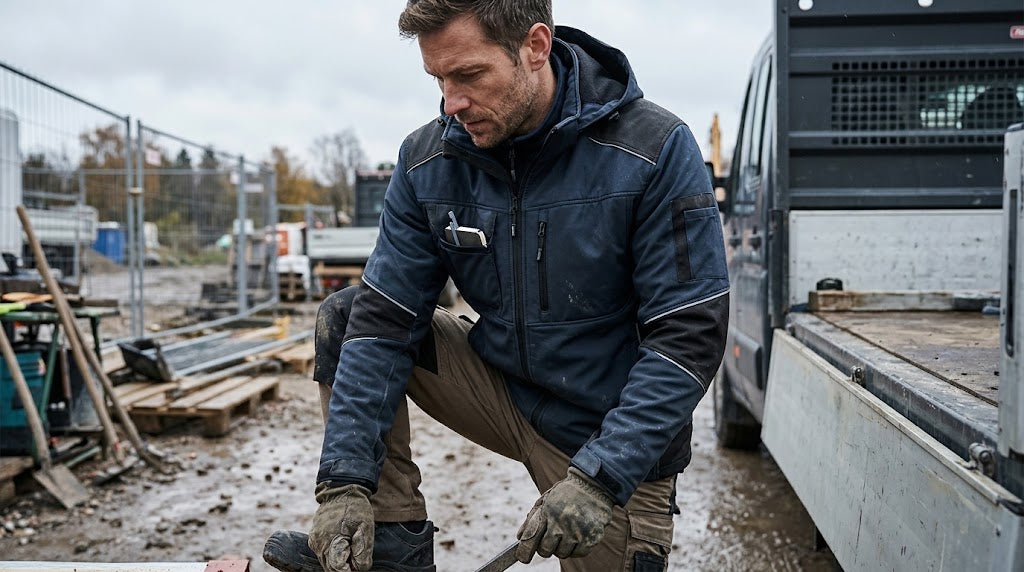
Layering system: Which jacket is for which task
Each layer has its own purpose. According to the manufacturer's guidelines in our range, it looks like this:
- Midlayer: Fleece and midlayers provide warmth and wick away moisture, such as the Schöffel PRO Einheizer made of 4-way Power Stretch fleece (92% polyester, 8% elastane) and the Dassy Convex Next with approximately 290 g/m²
- Softshell: wind- and water-repellent to waterproof, such as the Dassy Kalama with 5,000 mm and the Schöffel PRO Jedentag with a 10,000 mm water column
- Hardshell: Schöffel PRO Regenzeit, Schutzschild and Winterzeit with a 20,000 mm water column, plus the Dassy Hyper Next made of recycled polyester
- Winter jacket: padded, such as the Schöffel PRO Winterspeck with 150 g/m² padding and the Helly Hansen Berg with 160 g/m² insulation in the body area
- Hybrid jacket: softshell with padding for the transitional season, such as the Schöffel PRO Zweijahreszeiten with 100 g/m² padding and PLANAM Norit
- Work jacket: durable blended fabrics for the workshop, such as Mascot Industry and PLANAM Canvas 320 made of 65% polyester and 35% cotton
Our classification: The more waterproof the outer layer, the more important the midlayer becomes, which absorbs sweat and wicks it outwards. You can find more jackets for forestry and tree care under Forestry protection.
Water column, breathability, rating: What weather protection ratings mean
For rain jackets, three specifications are particularly important: the waterproof column in millimeters, breathability in grams per square meter per 24 hours, and the weather protection class. According to the manufacturer specifications in our range:
- Dassy Kalama: 5,000 mm waterproof column and 5,000 g/m² per 24 hours with three-layer softshell
- Schöffel PRO Jedentag and Einsteiger: 10,000 mm waterproof column, windproof, made of softshell
- Schöffel PRO Regenschutz: 2-layer packaway rain jacket with 10,000 mm and 10,000 g/m² per 24 hours
- Schöffel PRO Regenzeit, Schutzschild and Winterzeit: 20,000 mm and 20,000 g/m² per 24 hours
- Portwest H440: coated polyester with welded seams, according to the manufacturer EN 343 class 3:1 and EN ISO 20471 class 3
Regarding the standard: DIN EN 343:2019-06 has been withdrawn and replaced by DIN EN ISO 24232:2026-05. Many manufacturers still refer to EN 343 in their product specifications, such as Schöffel PRO for the Regenzeit with class 4/4/X. According to DGUV Information 212-016 (November 2025 edition), the weather protection standard divides clothing into classes 1 to 4. The higher the class, the better the protection against penetrating moisture and the moisture transport outwards. Class 1 must carry a warning note about limited wearing time, at least class 3 is recommended, class 4 offers the highest wearing comfort. These classes must not be confused with the classes of high visibility clothing.
Water-repellent is not waterproof: According to the manufacturer, the Schöffel PRO Blitzlicht is equipped with wind- and water-repellent features, the Schutzschild has fully taped seams, while the Dassy Minsk and the Dassy Nordix have welded seams. More about the standards is explained in the guide Weather protection clothing EN 343 and EN ISO 24232 explained clearly.
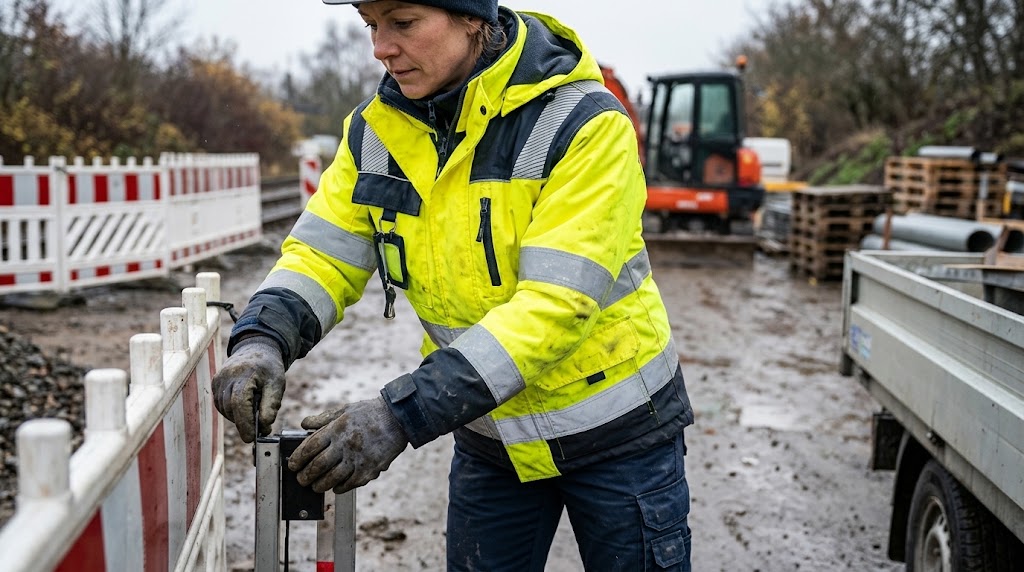
High-Visibility Jackets: Visibility and Weather Protection in One Jacket
High-visibility jackets combine high-visibility clothing according to DIN EN ISO 20471:2017-03 with weather or cold protection. Our range includes:
- Portwest H440 Hi-Vis Rain Jacket: EN ISO 20471 Class 3, welded seams, sizes S to 3XL
- Portwest Bizflame Rain S779: Multi-standard jacket as Category III PPE with protection against brief flame contact, electrostatic charge and light chemical splashes, removable fleece lining
- Schöffel PRO Neonwächter: Thermal fleece jacket according to EN ISO 20471 Class 3, sizes XS to 6XL
- Schöffel PRO Leuchtkegel: Softshell jacket with removable sleeves, Class 3 with sleeves, Class 2 as a vest
- Schöffel PRO Blitzlicht: Hardshell rain jacket according to EN ISO 20471 in high-visibility orange and navy
According to DGUV Information 212-016, high-visibility rainwear is manufactured in accordance with both the high-visibility clothing standard and the weather protection standard. In road traffic, only fluorescent yellow and fluorescent orange-red are permitted. You can find all models under High-Visibility Weather Protection. For more information on the classes, see the guide High-Visibility Clothing: Class 1, 2 or 3 according to EN ISO 20471.

Questions about work jackets
High visibility or weather protection: Do I need both?
High visibility or weather protection: Do I need both?
The risk assessment determines this. According to DGUV Information 212-016, high-visibility clothing for outdoor work must often also protect against wetness, wind and cold. In that case, a jacket that meets both high-visibility and weather protection standards may be suitable, such as the Portwest H440. The risk assessment determines which high-visibility class is required.
How warm is a winter jacket? What are high-visibility jackets known for, and when are they needed?
How warm is a winter jacket? What are high-visibility jackets known for, and when are they needed?
Manufacturers do not specify thermal performance in a uniform way. The Schöffel PRO Winterspeck features a Smawarm padding with 150 g/m², the Kachelofen Damen a recycled synthetic down padding with 180 g/m², the Zweijahreszeiten a padding with 100 g/m² and the Helly Hansen Berg 160 g/m² in the body area and 120 g/m² in the sleeves. Our assessment: Only compare padding in grams per square meter within the same type of garment.
What does ZipIn mean on Schöffel PRO jackets?
What does ZipIn mean on Schöffel PRO jackets?
According to the manufacturer, the ZipIn system allows compatible inner jackets to be zipped into the weather protection jacket, making the jacket suitable for year-round use. This is reflected in the names of several products, including the Schutzschild and Wetter-Fest weather protection jackets, the Einheizer fleece jacket, the padded Winterspeck, and the Zweijahreszeiten hybrid jacket. Which inner jacket is compatible with which outer jacket is stated in the respective product description.
What changes if I remove the sleeves from a jacket?
What changes if I remove the sleeves from a jacket?
For the Schöffel PRO high-visibility parka with removable sleeves, the manufacturer classifies the jacket as Class 3 and the sleeveless vest as Class 2. This is in line with DGUV Information 212-016: Class 3 garments must cover the torso and have at least long sleeves or long trouser legs with retroreflective strips. Therefore, check which version of the jacket you are wearing.
Which jacket is suitable for forestry and tree care?
Which jacket is suitable for forestry and tree care?
According to the manufacturer, the PFANNER Ventilation is an exceptionally lightweight forestry jacket for warm days, relying on air circulation with StretchAIR® and KlimaAIR® instead of a membrane. The PFANNER Wooltec jacket is made of pure merino wool and is particularly quiet. You can find more forestry clothing under Forestry Protection.
Weiterführende Links und Quellen
Quellen
- DGUV Information 212-016: Warnkleidung, Ausgabe November 2025
- DIN Media: DIN EN ISO 20471:2017-03, Hochsichtbare Warnkleidung
- DIN Media: DIN EN ISO 24232:2026-05, Schutz gegen Regen (ersetzt DIN EN 343:2019-06)
Herstellerangaben zu den Modellen: Produktinformationen von Schöffel PRO, Engel, Dassy, Mascot, PLANAM, BP, TRICORP, Portwest, Helly Hansen und PFANNER. Abgerufen am 30.10.2026.
Hinweis: Diese Seite informiert allgemein (Stand 30.10.2026). Welche Schutzausrüstung erforderlich ist, ergibt sich aus der Gefährdungsbeurteilung Ihres Unternehmens. Im Zweifel klären Sie die Auswahl mit Ihrer Fachkraft für Arbeitssicherheit.


