



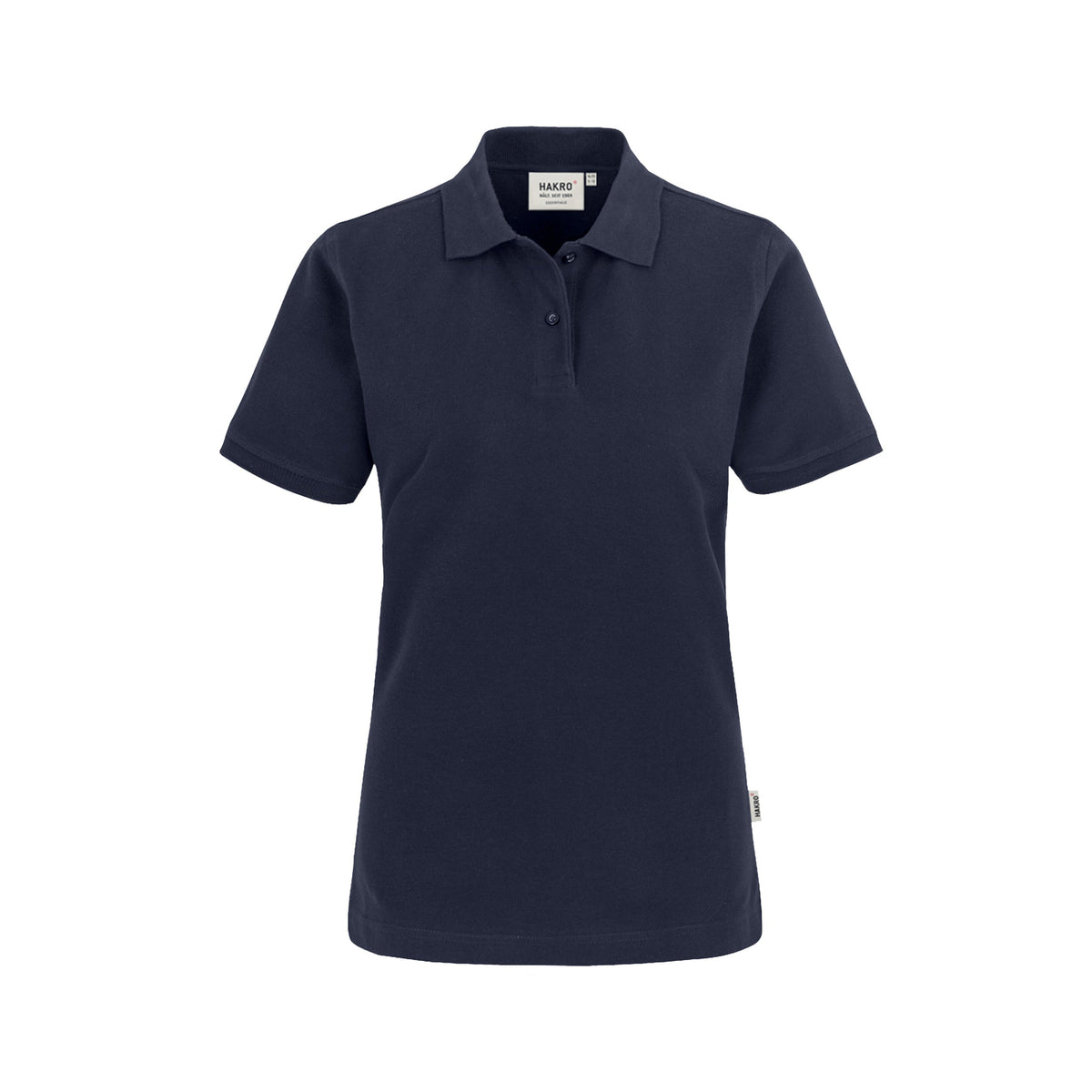


Workwear for joiners and carpenters: from the workbench to kitchen installation
A workday in a carpentry shop often begins at the sliding table saw and ends at the customer's home, where the new kitchen is accepted. The clothing needs to do both: withstand dust and chips in the workshop and look smart during installation. In this collection, you will find work trousers, bib and brace trousers, shorts, jackets, waistcoats and shirts in black, brown, sand, khaki and other colours. The majority of the range is the Redefined series from TRICORP, featuring Cordura reinforcements, stretch fabrics and cargo pockets. This is complemented by models from Dassy, Planam and Mascot, also available in women's cuts for women. Workwear alone is not enough to protect against wood dust, noise and splinters. The risk assessment determines what personal protective equipment your employees need. You can find the basic equipment under dust masks, hearing protection and safety glasses. If you also work with metal as well as wood, you will find additional models under Production and Manufacturing.
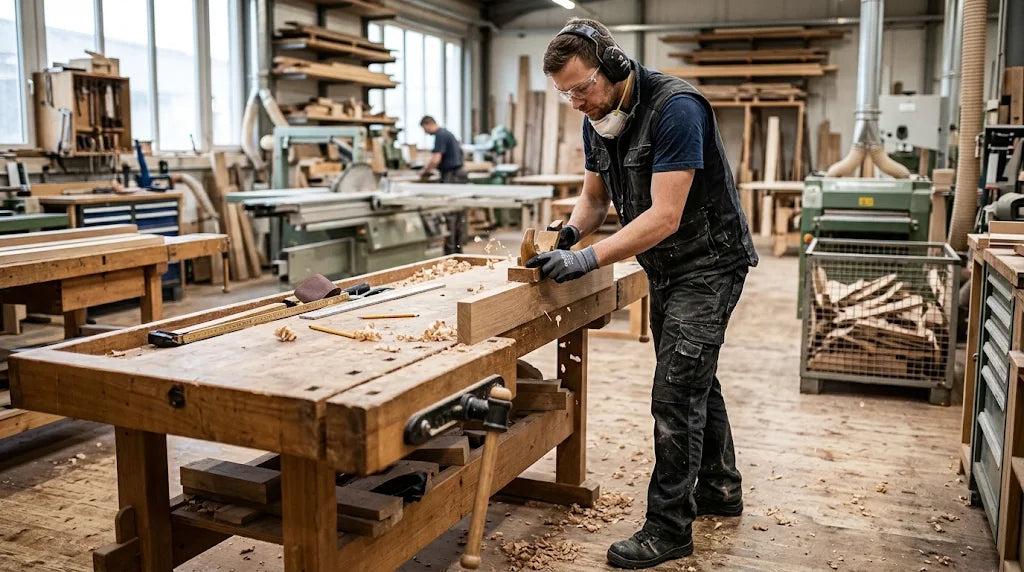
On the machine, only what doesn't get stuck counts
Circular saws, planers and table routers operate with open, fast-rotating tools. Anything that flutters or protrudes is dangerous: loose sleeves, open jackets, drawstrings, scarves and even gloves. Gloves are therefore prohibited on machines with rotating tools, because a caught glove will pull the hand in with it. Close-fitting clothing with cuffs on the sleeves has proven effective, long hair should be tied back and jewellery removed. When carrying panels and boards, assembly gloves are useful, but they must be removed before working on the machine.
What to check before purchasing
- Close-fitting cut without drawstrings and loose straps
- Cuffs or adjustable sleeve ends
- Flap pockets to prevent dust from accumulating
- Durable reinforcements on the knees and pockets
- Knee pad pockets for assembly and floor work
Wood dust: the underestimated risk in the workshop
Wood chips are visibly flying through the workshop, but the dangerous part is invisible: fine, inhalable wood dust. According to TRGS 906, dust from hardwoods such as beech and oak is classified as carcinogenic, while other wood types are suspected of having similar properties under TRGS 905. Wood dust can also cause skin and respiratory sensitization. TRGS 553 Wood Dust (2022 edition) draws clear conclusions from this:
- Exposure limit: On average, no more than 2 mg of inhalable wood dust per cubic meter of air may be present during a shift.
- Extraction first: Stationary machines and hand-held tools must be connected to dust extraction systems. Blowing off with compressed air is prohibited; dust must be collected using industrial vacuum cleaners of dust class M.
- Respiratory protection: Where the limit cannot be met despite extraction, employees must wear respiratory protection. It must also be made available upon request even if the limit is met.
- Preventive measures: For activities involving hardwood dust, occupational medical examinations must be offered in accordance with the ArbMedVV; if the exposure limit is exceeded, they are mandatory.
For clothing, this means: Smooth, tightly woven fabrics and pockets with flaps collect less dust and do not carry it into the break room, car, and home. Therefore, store work and street clothes separately and wash your work clothes regularly. Shaking and beating them out only stirs up the dust again. The risk assessment based on the STOP principle determines which measures are necessary in your workshop. The guide FFP2 or FFP3 explains which mask class is suitable for what.
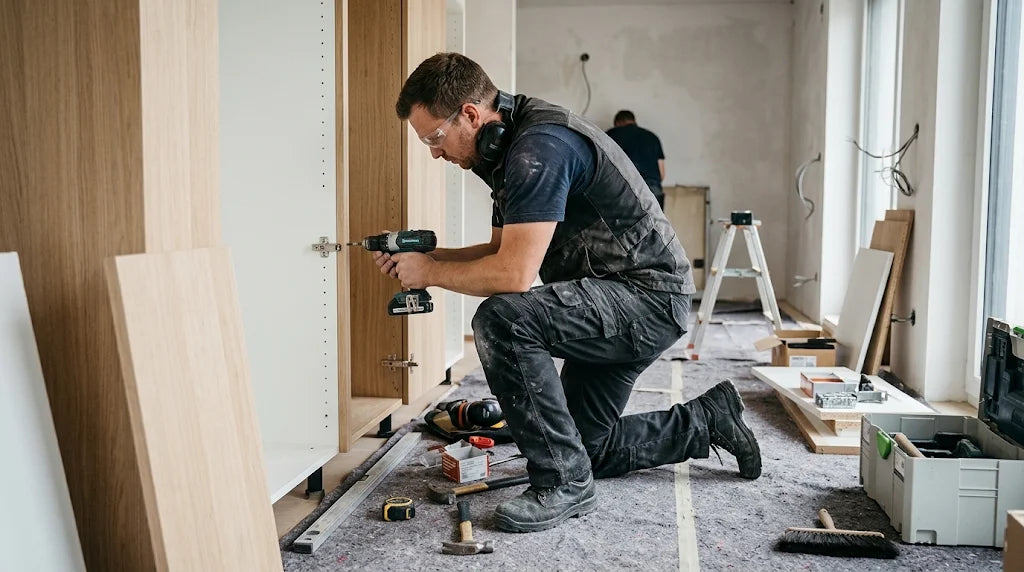
Workshop and assembly: two requirements, one equipment set
Carpenters work in two very different environments. In the workshop, durability and dust protection are essential, while at the customer's premises, a neat appearance and clothing that withstands kneeling and climbing are key.
- Workshop: durable trousers with a belt or bib, close-fitting shirt and sweatshirt, safety shoes based on the risk assessment.
- Installation: trousers with tool and knee pad pockets, polo shirt or softshell jacket for a professional appearance in residential interiors.
- Construction site: If nails or sharp objects are expected on the ground, S3 safety shoes with puncture resistance are the right choice; in the workshop, S1P are often sufficient.
A range like TRICORP Redefined covers both environments, as the trousers, shirt and jacket match in colour. We are happy to advise you on putting together the right outfit for your team via our contact form.

Frequently Asked Questions from Carpentry and Joinery
Why is wood dust so dangerous?
Why is wood dust so dangerous?
According to TRGS 906, dust from hardwoods such as beech and oak is classified as carcinogenic, particularly to the nasal mucosa. According to TRGS 553 (2022 edition), a limit value of 2 mg per cubic metre of air applies to all wood dust in the shift average. The most important protective measure is effective local exhaust ventilation at every machine.
Which mask protects you when sanding wood?
Which mask protects you when sanding wood?
To protect against wood dust, use particle filters, for example particle-filtering half masks of classes FFP2 or FFP3 according to EN 149:2001+A1:2009. The risk assessment determines which class is required. You can find masks under FFP2 and FFP3, and the glossary explains the differences under FFP masks.
Why are gloves prohibited when using a table saw?
Why are gloves prohibited when using a table saw?
Because a glove can be caught by the rotating saw blade or cutter, pulling the hand in with it. Gloves are therefore not worn when operating machines with rotating tools. However, assembly gloves are useful for carrying panels and raw timber.
Can I blow away chips with compressed air?
Can I blow away chips with compressed air?
No. Blowing it out with compressed air stirs up the fine dust and is not permitted under TRGS 553. Chips and dust are collected using an industrial vacuum cleaner of dust class M. Dry sweeping is only permitted in exceptional cases.
What hearing protection is suitable for a planer and circular saw?
What hearing protection is suitable for a planer and circular saw?
According to the Noise and Vibration at Work Regulation, hearing protection is mandatory when the daily noise exposure level reaches 85 dB(A), levels that planers and circular saws can quickly reach. For short, recurring tasks, earmuffs are practical, while earplugs are often better for all-day wear. The guide Hearing Protection dB Table explains how much attenuation you need.
Weiterführende Links und Quellen
Die Auswahl der Schutzausrüstung richtet sich nach der Gefährdungsbeurteilung Ihres Unternehmens.