


Summary (as of 14.11.2026)
Good work trousers suit the task, the conditions on site and the wearer's build. Trousers, bib and brace and shorts serve different purposes. Poly-cotton, canvas, Cordura reinforcements and stretch determine durability and freedom of movement. Knee pad pockets only protect with the matching knee pad according to DIN EN 14404-3:2024-10. If you know regular, short and long fittings, you will find the right fit for every team member.
Work trousers are put to the test every day in trades and industry: kneeling on concrete, climbing scaffolding, tools in every pocket and regular washing. Cheap trousers quickly tear at the knees and pockets, poorly chosen trousers pinch or slip. This guide shows which types of work trousers exist, which materials have proven themselves, what matters with pockets and knee pads, and how to find the right sizes for women and men.
Trousers, bib and brace or shorts: which style for which work?
The style depends on the work that is mainly carried out:
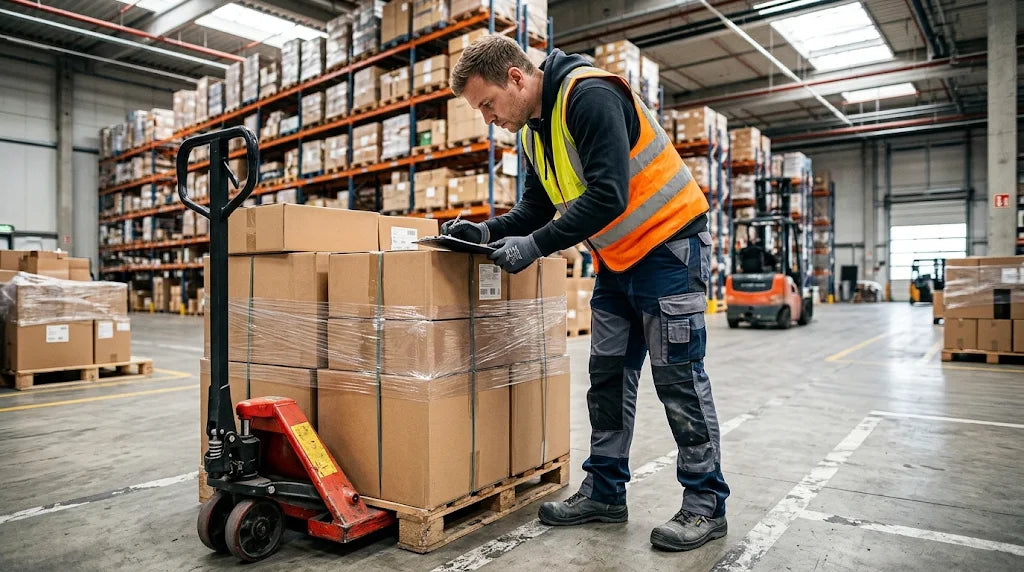
- Trousers are the most versatile style. They sit at the waist, combine well with jackets and shirts and are suitable for workshops, assembly and warehouses.
- Bib and brace trousers also protect the torso from dirt and offer more space for pen, folding rule and phone in the chest pocket. Nothing slips when bending, which is why they are popular with painters, carpenters and on construction sites.
- Shorts are intended for warm days and work without kneeling. On sites with a risk of leg injuries, long trousers are usually required.
Many companies therefore equip tradespeople with two pairs of work trousers: trousers or bib and brace for everyday work and shorts for the summer. You can find all styles at Technigro under trousers, bib and brace and shorts.
Materials: what makes work trousers durable
The durability of work trousers depends mainly on the fabric. Robust work trousers withstand hard work on site for years. These materials are common:
| Material | Properties | Typical use |
|---|---|---|
| Polyester and cotton blend | Robust, keeps its shape, dries quickly, suitable for industrial laundering | Workshop, industry, warehouse |
| Cotton or canvas | Comfortable on the skin, breathable, canvas very dense and hard-wearing | Carpenters, joiners, construction |
| Cordura reinforcements | Polyamide fabric with high abrasion resistance at knees and pockets | Construction, assembly, landscaping |
| Stretch with elastane | More freedom of movement when kneeling, bending and climbing | Assembly, electrical work, painters |
Modern work trousers combine these materials specifically: a robust base fabric, Cordura at the knees and pocket edges and stretch inserts in the crotch or back. Pay attention to the fabric weight. Heavy fabrics last longer for heavy work, lighter materials are more comfortable in summer. The manufacturer's care instructions show whether a pair of trousers is suitable for industrial laundering according to ISO 15797.
Pockets: order for tools and accessories
Pockets are more than a detail on work trousers. Depending on the trade, people need different pockets:
- Holster pockets hang outside at the waistband and hold screws, nails and small tools. On many models they can be removed or tucked in.
- Folding rule pockets sit on the side of the thigh so the rule does not press when kneeling.
- Leg pockets with flaps keep phone, ID card or notepad secure.
- Tool loops and hammer loops are practical for carpenters, drywall installers and fitters.
More pockets are not automatically better. For work on machines, smooth trousers without protruding pockets are safer because nothing can get caught.
Knee pad pockets and knee protection according to DIN EN 14404
Many work trousers have knee pad pockets. On their own, however, they hardly protect the knee. Only an inserted knee pad distributes the pressure when working on the floor. The DIN EN 14404 series was revised in October 2024 and replaces the old EN 14404:2004+A1:2010. Knee pads that are combined with trousers are called type 2.
- DIN EN 14404-3:2024-10: Knee pad and trousers are tested as an individual combination. The trouser label then names the matching knee pad.
- DIN EN 14404-4:2024-10: Interoperable knee pads that fit into various suitable trousers.
Performance levels 0, 1, 1U and 2 indicate which floors the knee protection is suitable for, level 0 only for flat surfaces without a risk of penetration. Important: the protection only applies to the tested combination. Any pad in any pair of trousers is not standard-compliant knee protection. You can find suitable knee pads in our range.
Sizes and fit: how to find the right work trousers
The fit determines whether trousers stay comfortable all day. Men's work trousers usually come in three size systems:
| Sizes | Typical range | For whom |
|---|---|---|
| Regular sizes | approx. 42 to 64 | Men with average leg length |
| Short sizes | approx. 24 to 31 | Men with shorter legs and a stockier build |
| Long sizes | approx. 90 to 110 | Men with longer legs and a slimmer build |
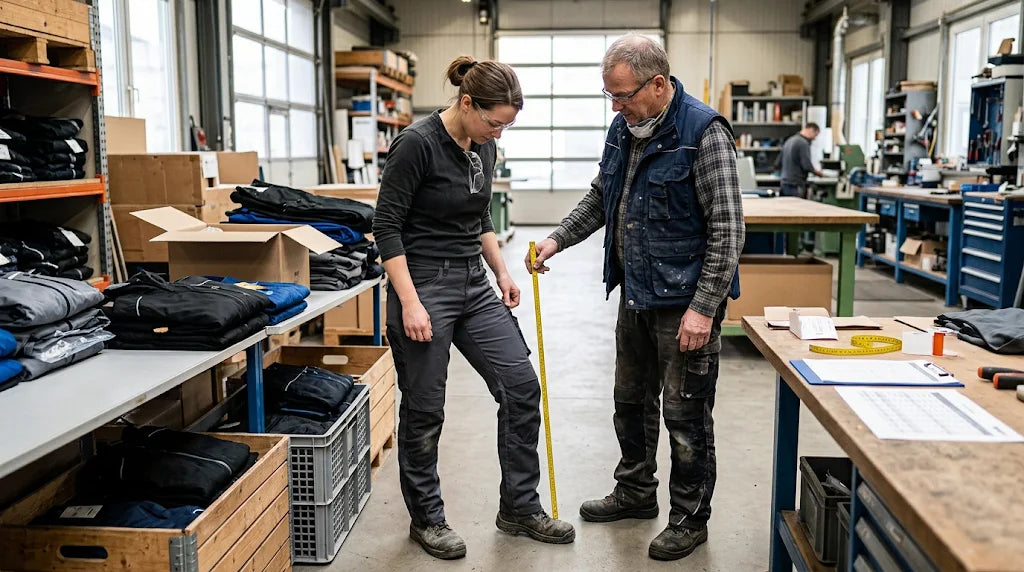
Exact sizes vary by manufacturer. Measure waist, hips and inside leg and compare the values with the size chart on the respective product. For women there are separate cuts with adapted hips and rise that are available in many of the men's ranges. You can find them under women's workwear.
For a team, it is worth collecting sizes in advance and trying on individual models. Especially for men with a strong build or long legs, choosing the right size avoids returns. Also make sure that trousers, jackets and shirts from the same range match in colour so that the whole team looks consistent.
Frequently asked questions about work trousers
Which work trousers are best for tradespeople?
For most trades, trousers or bib and brace made of poly-cotton with Cordura at knees and pockets, stretch inserts and knee pad pockets have proven themselves. Which work trousers fit best depends on the trade: painters need different pockets than carpenters or electricians.
How do work trousers size up?
Men's work trousers usually follow German garment sizes with regular, short and long sizes. Sizes can vary slightly by brand. Always compare your measurements with the manufacturer's size chart before ordering work trousers for a whole team.
How many pairs of work trousers does an employee need?
At least two to three pairs per person have proven themselves, so that one pair can always be washed. For very dirty work or with a rental laundry service, more pairs are often in circulation.
Are work trousers available in large sizes?
Yes. Many ranges go up to large regular sizes for men and also offer short and long sizes. This means that men with a strong build or very long legs can also find work trousers with a good fit.
Checklist: choosing work trousers for the team
- Tasks recorded: kneeling, climbing, work on machines and outdoor work
- Style chosen: trousers, bib and brace or additional shorts for the summer
- Materials suitable for the use: poly-cotton, canvas, Cordura reinforcements or stretch
- Pockets by trade: holster pockets, folding rule pocket, no protruding pockets at machines
- Knee pad pockets with approved knee pad according to DIN EN 14404-3 or 14404-4
- Sizes and fit clarified per person, women's and men's cuts considered
- Care clarified, if necessary suitability for industrial laundering according to ISO 15797
Work trousers at Technigro
At Technigro you can find work trousers for women and men from brands such as Dassy, Engel, Mascot, Planam, Schöffel PRO and TRICORP. Companies order via the B2B program with tiered prices on a company account. Suitable trousers for individual trades are shown on the pages painters and decorators and joinery and woodworking.
Note: This article provides general information (as of 14.11.2026). Whether special protective clothing or knee protection is required at a workplace is determined by your company's risk assessment.
Sources
- DGUV, foot protection section: FAQ on knee protection according to DIN EN 14404:2024. Accessed on 14.11.2026.
- DGUV: details on knee protection according to DIN EN 14404:2024, marking and performance levels. Accessed on 14.11.2026.
- DIN EN 14404-3:2024-10, knee protection, individual combination of knee pads and garments (type 2), DIN. Accessed on 14.11.2026.
- ISO 15797:2017, industrial washing and finishing procedures for testing workwear.