

Summary (as of 13.11.2026)
Multi-norm protective clothing combines several protective functions in one garment, for example protection against heat and flame according to DIN EN ISO 11612, welding protection according to DIN EN ISO 11611, antistatic properties according to DIN EN 1149-5 and arc flash protection according to EN 61482-2. It makes sense when several hazards occur at one workplace. The risk assessment determines which standards the clothing must meet.
In energy supply, chemicals or metalworking, several hazards often meet: sparks during welding, flames at installations, electrostatic discharge in potentially explosive areas or an arc flash at the switchgear. In the past, this meant keeping several protective suits and changing depending on the task. Multi-norm protective clothing solves the problem with a single garment that protects the wearer according to several standards at once. This guide explains which tests are behind it, who benefits from multi-norm and what companies should consider when selecting, wearing and caring for it.
What does multi-norm mean?
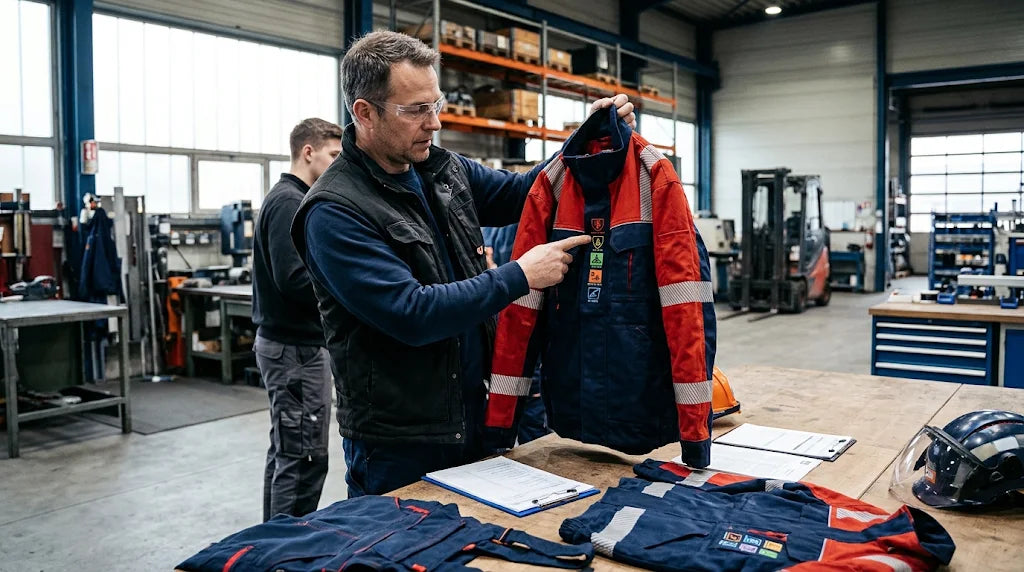
Multi-norm is not a standard of its own, but a term for protective clothing that is tested and certified according to several standards at the same time. The basis for all protective clothing is DIN EN ISO 13688 with the general requirements for fit, size designation and marking (EN ISO 13688:2013+A1:2021). The individual protective functions build on this. A multi-norm suit is personal protective equipment according to Regulation (EU) 2016/425 and not simply a piece of workwear.
For the wearer, this has a clear advantage: they are protected throughout changing tasks without having to change clothes. For the company, multi-norm simplifies procurement because one model covers several workplaces. The price is usually higher than that of simple workwear, but a second or third set of protective clothing is no longer needed.
The most important standards at a glance
The label and the manufacturer's information state which protective functions a multi-norm garment covers. These test standards are the most common:
| Standard | Protection against | Marking |
|---|---|---|
| DIN EN ISO 11612 (EN ISO 11612:2015) | Heat and flame | Code A1 or A2 for limited flame spread, B to F for convective heat, radiant heat, molten aluminium and iron and contact heat |
| DIN EN ISO 11611 (EN ISO 11611:2015) | Welding spatter and brief flame contact during welding | Class 1 for processes with little spatter, class 2 for more hazardous processes |
| DIN EN 1149-5 (EN 1149-5:2018) | Ignition sparks from electrostatic charge | Antistatic clothing for potentially explosive areas |
| EN 61482-2:2020 (IEC 61482-2:2018) | Thermal hazards of an electric arc | Protection class APC 1 (tested at 4 kA) or APC 2 (tested at 7 kA), alternatively ELIM value |
| EN 13034 (EN 13034:2005+A1:2009) | Splashes of liquid chemicals | Type 6 or type PB [6] for partial body protection |
| DIN EN ISO 20471 (EN ISO 20471:2013+A1:2016) | Being overlooked | High visibility class 1, 2 or 3 |
A typical multi-norm garment for energy supply meets, for example, DIN EN ISO 11612, DIN EN ISO 11611, DIN EN 1149-5 and EN 61482-2 at the same time. For work on roads and railways, the high visibility standard is added. The glossary explains individual tests under EN ISO 11612, EN ISO 11611 and EN 1149-5.
Who benefits from multi-norm protective clothing?
Multi-norm is worthwhile wherever the wearer is exposed to several hazards at the same time or in quick succession. Typical areas of use are:
- Energy supply and electrical engineering: work on switchgear where the wearer must be protected against an arc flash, often combined with heat and flame.
- Chemicals, petrochemicals and gas supply: work in potentially explosive areas where antistatic clothing and flame protection are required, sometimes with chemical splashes.
- Metalworking and steel construction: welding, flame cutting and work on hot surfaces.
- Petrol station and plant construction: installation and maintenance on systems with flammable liquids and gases.
- Rail and road: work on overhead lines or in traffic areas where high visibility is also required.
Where there is only a single hazard, such as pure welding in the workshop, special welding protective clothing is often sufficient. Multi-norm is not an end in itself: every additional protective function usually makes the fabric heavier.
What to look for when selecting
The starting point is always the risk assessment according to Section 5 of the German Occupational Safety and Health Act. It clarifies which hazards exist at the workplace and therefore which standards and performance levels the protective clothing must meet. For arc flash, DGUV Information 203-077 specifies a procedure for determining the required protection class. These questions help with the selection:
- Which standards are required? Compare the list from the risk assessment with the label. Each standard must be listed with the required performance level.
- Which performance level is sufficient? A higher level offers more protection, but often makes the clothing heavier and warmer.
- Does the clothing suit the job? Freedom of movement, pockets and wearing comfort determine whether the wearer keeps the clothing on all day.
- Do all parts fit together? Jacket and trousers often only fully protect the wearer as a combination, for example against arc flash. Check the manufacturer's information.
Wearing it correctly: keeping the protection intact
Multi-norm protective clothing only protects if it is worn correctly. Every wearer should know these rules, they are particularly important for their safety:
- Wear it closed: close the jacket completely, do not roll up sleeves and trouser legs. Open clothing does not offer full protection against flames and sparks.
- Antistatic effect needs earthing: antistatic clothing according to DIN EN 1149-5 only dissipates charge if the wearer is earthed, for example via dissipative safety shoes. In potentially explosive areas, the clothing must not be opened or taken off.
- Suitable underwear: do not wear underwear made of melting synthetic fibres under flame protection, preferably cotton or flame-retardant underwear that complements the protection.
- No third-party patches: subsequently applied logos, stickers or untested appliqués can impair the protective functions.
Wearing comfort: why it decides on protection
The best protective clothing is useless if the wearer opens or takes it off in the heat. That is why wearing comfort is just as important for multi-norm as the number of protective functions. Modern fabrics are lighter and more breathable than earlier generations, so the wearer does not overheat even during physical work. Stretch inserts, pre-shaped knees and a good fit ensure freedom of movement. Many manufacturers now offer multi-norm in the cut and look of normal workwear, with pockets for tools, measuring devices and radio. The protective clothing then hardly feels different from familiar workwear, and for the company acceptance and safety increase. Have new models tested by some employees in everyday use before purchasing. Protection comes first, but only comfortable workwear is worn consistently.
Care and inspection of multi-norm clothing
Correct care is crucial to maintaining the properties of the clothing. Only wash multi-norm protective clothing according to the care label. Many models are suitable for industrial laundering. Fabric softener and bleach can weaken flame-retardant and antistatic properties and should be avoided. Heavily soiled clothing, for example with oil or grease, is a fire risk and is washed immediately.
Before each use, the wearer checks the clothing for tears, holes, burn marks and defective fastenings. If the wearer finds damage or the number of wash cycles specified by the manufacturer has been reached, the clothing is replaced. This maintains safety over the entire service life.
Multi-norm protective clothing at Technigro
At Technigro you can find multi-norm protective clothing from brands such as BP, Engel, Dassy and Portwest in the multi-norm protective clothing collection, including jackets, trousers, bib and brace and high visibility models. The product description states which certifications a model has. Further workwear for workshop and industry can be found under production and manufacturing. The glossary explains the term under multi-norm clothing, and the guide choosing the right PPE gives an overview of all PPE standards.
Note: This article provides general information (as of 13.11.2026). Which protective clothing is required is determined by your company's risk assessment. In case of doubt, clarify the selection with your occupational safety specialist.
Sources
- Kübler: IEC 61482-2, protection classes APC 1 and APC 2, ELIM and ATPV, manufacturer information. Accessed on 13.11.2026.
- EN 61482-2:2020, protective clothing against the thermal hazards of an electric arc (IEC 61482-2:2018). Accessed on 13.11.2026.
- Manufacturer information on multi-norm protective clothing with EN ISO 13688:2013+A1:2021, EN ISO 11611:2015, EN ISO 11612:2015, EN 1149-5:2018 and EN 13034:2005+A1:2009. Accessed on 13.11.2026.
- DGUV Information 203-077, thermal hazards from electric arcs, DGUV.
- Regulation (EU) 2016/425 on personal protective equipment, and German Occupational Safety and Health Act, Section 5.