



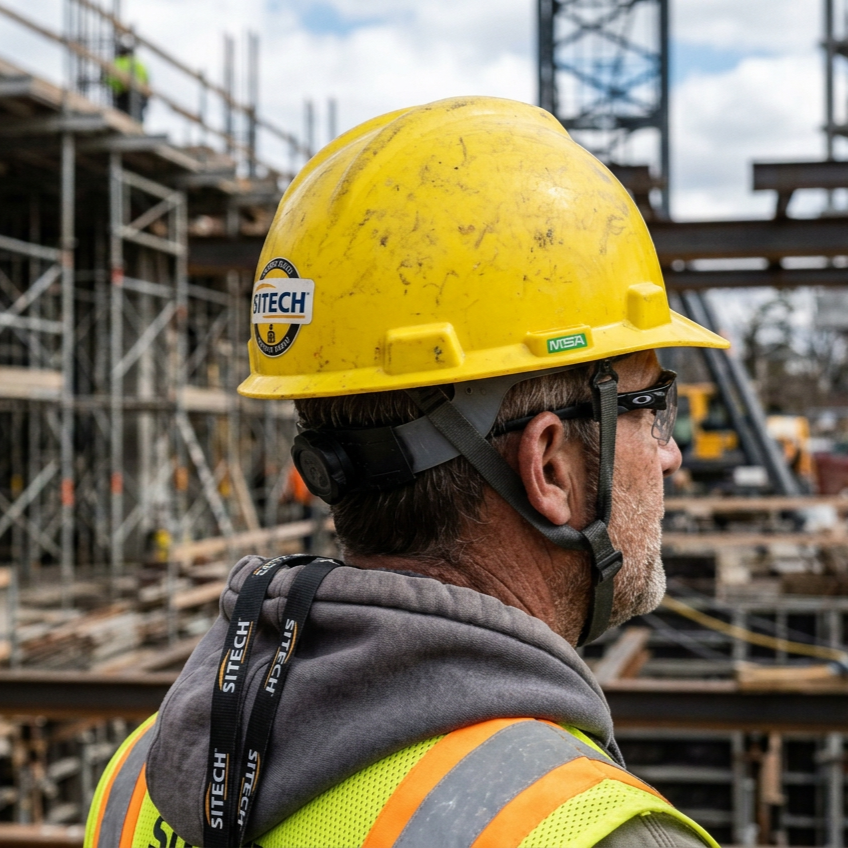
Summary (as of 27.10.2026)
Under Section 5 of the Occupational Safety and Health Act, Section 2 of the Personal Protective Equipment Ordinance, and DGUV Rule 112-193, companies must provide suitable head protection when there is a risk of injury from falling objects, swinging loads, or bumping into obstacles. On construction sites, the industrial safety helmet according to the new DIN EN 397:2026-07 (EN 397:2025+AC:2025) is the standard, which now distinguishes between helmet type 1 (protection in the crown area) and helmet type 2 (additional side and all-round protection). Industrial bump caps according to DIN EN 812 protect exclusively against bumping into fixed components and must never replace a safety helmet.
On construction sites, in steel and plant construction, or during maintenance, a brief moment of carelessness is all it takes: a tool falling from scaffolding, a swinging load on a crane hook, or a low steel beam at head height can cause severe head and skull injuries. This is why head protection is considered essential basic equipment in the construction industry and many industrial sectors.
However, not every helmet or bump cap protects against the same physical impacts. Furthermore, the classification of industrial safety helmets has been fundamentally revised with the updated DIN EN 397:2026-07 standard. This guide shows safety officers and purchasers which types of head protection are distinguished by DGUV Rule 112-193, what lies behind the new helmet types 1 and 2, how to recognize the durability of helmet shells, and when a helmet must be replaced immediately.
When is head protection mandatory on construction sites and in the workplace?
There is no blanket helmet requirement stated as a rigid rule in the law; instead, it arises directly from the workplace risk assessment under Section 5 of the Occupational Safety and Health Act (ArbSchG) and Section 2 of the Personal Protective Equipment Ordinance (PSA-BV). The requirements are specified by the DGUV Rule 112-193 "Use of Head Protection". If the assessment of working conditions shows that employees are exposed to a risk of head injury despite technical measures (such as safety nets or toe boards on scaffolding) and organizational measures (such as cordoned-off hazardous areas), the company must provide suitable head protection free of charge and enforce its use.
Typical hazards and activities requiring a safety helmet according to DGUV Rule 112-193 include:
- Mechanical impacts: Falling, falling over, or flying objects, swinging loads within the operating range of cranes, excavators, and lifting equipment, and bumping into edges, pipes, or scaffolding components in confined spaces.
- Thermal, chemical, and electrical hazards: Contact with splashes of molten metal, intense radiant heat, hazardous liquids, or live plant components.
- Typical construction site and industrial areas: Civil engineering, demolition and deconstruction work, scaffolding, crane and forklift operations involving suspended loads, sewer, shaft, and tunnel construction, steel and assembly work, and tree felling and forestry work.
Our basic guide Occupational Safety vs. Workplace Safety explains how the hierarchy of measures for technical, organizational, and personal protection is legally structured. Every piece of head protection used falls under Regulation (EU) 2016/425 (PPE category II or category III for special risks such as electrical work and extreme heat) and must bear the CE mark.
What types of head protection are there? An overview of the standards
Depending on the hazard profile at the workplace, five different types of head protection are used, each tested according to its own European standard:
| Type of head protection | Applicable standard | Tested protective effect | Typical application area |
|---|---|---|---|
| Industrial safety helmet type 1 | DIN EN 397:2026-07 (Type 1) | Shock absorption (49 joules test energy) and penetration resistance in the upper crown area against objects falling vertically | General civil engineering work, assembly, logistics with crane operations, workshops |
| Industrial safety helmet type 2 (formerly also DIN EN 14052) | DIN EN 397:2026-07 (Type 2) | Shock absorption and penetration resistance in the crown area as well as additionally outside the crown (side, front, and back) | Demolition, scaffolding and steel construction, crane work with swinging loads, confined spaces with forced postures |
| Climbing and height-work helmet | DIN EN 12492:2012-04 | Shock absorption from above and from the sides, secure multi-point chin strap fastening (holding force at least 500 N), so that the helmet does not slip off the head during a fall | Rope access, work on masts, wind turbines, roof work with a risk of falling |
| Electrically insulating safety helmet | DIN EN 50365:2023-10 | Mechanical head protection combined with electrical insulation (Class 0 to 1,000 V AC or 1,500 V DC), without ventilation openings | Electrical installation, switchgear construction, work near live parts (PPE category III) |
| Industrial bump cap | DIN EN 812:2012-04 | Low shock absorption (12.5 joules test energy) exclusively against bumping the head against fixed, hard components | Interior assembly, automotive pits, maintenance under pipes or shelves without any risk of falling parts |
For electrical workers, an important note applies to helmets according to DIN EN 50365: The helmet protects the head against dangerous body currents when live parts are touched, but it does not protect the face alone from the thermal effects of an electrical arc. According to DGUV Information 203-077, an additional, arc-flash-tested face shield is required. You can find suitable safety helmets for construction sites, assembly, and special applications in our range.
New features of DIN EN 397:2026-07: What distinguishes helmet type 1 from helmet type 2?
With the publication of DIN EN 397:2026-07 (European version EN 397:2025+AC:2025), the previous standard from 2013 was fundamentally revised and replaced. In the old standard version, the shock absorption and penetration resistance of an industrial safety helmet were tested exclusively within a narrow radius around the highest point of the helmet (the crown area). However, on real construction sites, impacts from swinging crane loads, collapsing formwork components, or during a fall from a low height often strike the head on the side, the forehead, or the back of the head.
The current DIN EN 397:2026-07 closes this protection gap by systematically integrating the requirements of the earlier high-performance helmet standard DIN EN 14052 and introducing two clearly defined helmet types:
- Helmet type 1 (crown protection): Meets the classic basic requirements for shock absorption (a 5-kilogram test body falls on the helmet from a height of 1 meter, whereby the maximum force transmitted to the test head must not exceed 5.0 kilonewtons) as well as the penetration test with a pointed 3-kilogram test cone exclusively in the upper crown area.
- Helmet type 2 (crown and all-round protection): In addition to the test in the crown area, it must pass additional shock absorption and penetration tests outside the crown area (front, side, and back). Furthermore, the standard places enhanced requirements on the fit and retention system of type 2 helmets so that the helmet remains securely on the head even during oblique impacts.
The distinction is also crucial for the chin strap when conducting a risk assessment: In an industrial safety helmet according to DIN EN 397, the chin strap is designed to open deliberately at a tensile force between 150 and 250 newtons (breakaway point). This prevents employees from being strangled on the ground if the helmet gets caught on a machine part or reinforcing steel. In contrast, the chin strap of a climbing helmet according to DIN EN 12492 withstands a force of at least 500 newtons so that the helmet is not pulled off the head during a free fall while roped. Modern combination helmets, therefore, offer a practical solution for height work; they are tested according to both DIN EN 397 and DIN EN 12492 and partially feature a switchable chin strap.
Safety helmet according to DIN EN 397 or bump cap according to DIN EN 812?
In everyday operations, textile industrial bump caps with an integrated plastic shell are often requested because of their low weight and sporty appearance. However, there is a considerable difference between the two products from a safety and physical perspective:
- Comparison of test energy: An industrial safety helmet according to DIN EN 397 is tested with an impact energy of 49 joules (5 kg from a height of 1 m) on a stationary test head. An industrial bump cap according to DIN EN 812 is tested with only 12.5 joules (5 kg from a height of 0.25 m). This corresponds to only around a quarter of the energy absorption and simulates solely the walking movement of a person bumping their own head against a rigid obstacle.
- Design difference: A safety helmet has a defined crumple and damping zone of several centimeters between the hard outer shell and the suspension system (or solid foam core), which distributes point impact forces across the entire skull. A bump cap lacks this damping distance.
According to DGUV Rule 112-193, therefore, the rule is strict: An industrial bump cap according to DIN EN 812 offers no protection against falling or swinging objects and must never be used on construction sites or under crane tracks as a replacement for an industrial safety helmet.
Additional requirements and markings in the industrial safety helmet
Every standardized safety helmet bears permanently embossed markings on the inside of the visor or helmet shell. In addition to the standard number (DIN EN 397), the manufacturer, the model, the size, the year and quarter of manufacture, and the abbreviation of the shell material, these markings also include the abbreviations for passed optional additional tests:
| Abbreviation in the helmet | Tested additional requirement | Relevance for workplace use |
|---|---|---|
| -20 °C or -30 °C | Very low temperatures (the basic test is conducted down to -10 °C) | Mandatory for winter construction sites, cold storage facilities, and assembly work in severe frost, as unsuitable plastics become brittle in the cold and splinter upon impact |
| +150 °C | Very high temperatures (the basic test is conducted at +50 °C) | Hot workplaces in foundries, steelworks, glassworks, or near industrial furnaces |
| 440 V a.c. | Electrical insulation during brief, unintentional contact with alternating voltage up to 440 volts | Additional protection in general construction; for planned work on live equipment up to 1,000 V, a helmet according to DIN EN 50365 is required instead |
| LD (Lateral Deformation) | Resistance to lateral deformation (transverse pressure load up to 430 N) | Activities with a risk of crushing around the head, such as in scaffolding, timber construction, trench shoring, or maneuvering heavy components |
| MM (Molten Metal) | Resistance to splashes of molten metal (150 g of liquid iron at approx. 1,400 °C) | Metalworking, foundries, flame cutting, and welding environments |
For use in potentially explosive areas (ATEX zones), safety helmets must also be designed to be electrostatically conductive according to DGUV Rule 112-193 and DIN EN ISO 80079-36, so that no ignitable charge builds up on the plastic shell. You can find an overview of our entire range in our Head Protection category.
Helmet materials, service life, and replacement readiness according to DGUV Rule 112-193
The service life of an industrial safety helmet depends largely on the material of the helmet shell and the environmental conditions at the place of use. DGUV Rule 112-193 distinguishes two material groups with completely different aging characteristics:
| Material group and abbreviation | Material properties in use | Aging and guideline value for service life |
|---|---|---|
| Thermoplastic plastics (PE, HDPE, ABS, PC, PA) | Low weight, good color options, moisture-resistant; ABS and polycarbonate (PC) offer high mechanical strength even in the cold | Aging due to UV radiation (sunlight), weather, and chemical vapors; the material becomes brittle over time. Guideline value according to DGUV Rule 112-193: 4 years of service life (for high-quality ABS/PC helmets, up to 5 years from the date of manufacture depending on the manufacturer's approval, plus storage time). |
| Duroplastic plastics (PF-SF / phenolic resin-textile, UP-GF / glass fiber-polyester) | Exceptionally resistant to heat, deformation, and chemicals; no melting or dripping under extreme radiant heat or splashes of molten metal | Virtually no UV-induced material embrittlement. Guideline according to DGUV Rule 112-193: 8 to 10 years of service life (The manufacturer's specifications and the integrity of the fiber structure are decisive). |
Regarding the date stamp on the helmet visor: The embossed "material clock" (circle with the year in the center and an arrow pointing to the month or quarter) indicates the manufacturing date of the helmet shell, not the expiration date. The maximum storage and service life specified in the manufacturer's instructions for use always determines the latest possible replacement date.
Regardless of its age, a safety helmet immediately reaches its end of service life and must be withdrawn from use if any of the following apply:
- The helmet has absorbed a hard blow or the impact of a falling object (even if no crack is visible on the outside, there may be hairline cracks in the shell or overstretched chin strap attachments).
- The helmet shell shows visible cracks, deep scratches, deformation, or surface fading and chalking due to UV radiation.
- In helmets made of thermoplastic plastic (without fiber reinforcement), the so-called crack test according to DGUV Rule 112-193 reveals crackling or snapping sounds when the helmet shell is gently squeezed together sideways with both hands or the visor is gently bent (indicating advanced embrittlement).
- The interior fittings (suspension straps, neck strap, ratchet buckle) are torn, deformed, or can no longer be securely locked.
Furthermore, never apply stickers, solvent-based paints, or markings with permanent markers to the helmet shell yourself unless expressly approved by the manufacturer: adhesives and solvents penetrate the plastic and make the shell brittle at that point.
Combining fit, comfort, and approved accessories
On construction sites, a helmet is often worn for eight hours at a time. A six-point textile suspension system that distributes the weight evenly over the head, a one-handed ratchet buckle at the back for an adjustable fit (head sizes usually 52 to 64 cm), replaceable welding caps, and adjustable ventilation slots for summer ensure high user acceptance.
Safety helmets often need to be combined with additional personal protective equipment. Standardized 30-millimeter plug-in slots (Euroslots) on the sides of the helmet allow earmuffs according to DIN EN 352-3, as well as visors and face shields for eye protection according to DIN EN 166 or DIN EN ISO 16321-1, to be attached directly to the helmet (the article Safety glasses marking: EN 166 and EN ISO 16321 explained explains the marking). In winter, thin fleece balaclavas protect against cold, while neck protectors shield against UV radiation in summer. Important according to § 2 PSA-BV and DGUV Rule 112-193: Use exclusively head protection and accessories that have been tested and approved by the helmet manufacturer together with the respective helmet model in the declaration of conformity. A thick hood from a regular hooded sweatshirt must not be worn under the helmet, as the suspension system will no longer fit snugly around the head.
Checklist: Selecting and inspecting head protection in the company
- Risk assessment carried out according to § 5 ArbSchG and DGUV Rule 112-193 (mechanical hazards, side impacts, electrical hazards, heat, cold, work at height)
- Safety helmet specified according to DIN EN 397:2026-07 (Type 1 for top protection or Type 2 for additional side protection) or special helmet according to DIN EN 12492 or DIN EN 50365
- Bump caps according to DIN EN 812 strictly limited to workplaces without the risk of falling or swinging objects
- Helmet shell material (thermoplastic such as ABS/PE or duroplastic for hot work) and additional markings (-30 °C, LD, MM, 440 V a.c.) selected to suit the place of use
- Accessories (plug-in earmuffs, visor, chin strap, winter balaclava) checked for manufacturer approval for the exact helmet model
- Maximum service life from the manufacturing date documented and regular visual inspection (including the crack test for thermoplastics) incorporated into the safety instructions
At Technigro: Head protection and construction site PPE for your company
At Technigro, you will find tested head protection as well as a full range of complementary construction site equipment, from highly visible high-visibility clothing to penetration-resistant S3 safety shoes and robust protective gloves. Companies can conveniently order their ongoing PPE requirements through the B2B program using a corporate account.
Find out which high-visibility class is required on construction sites within the vicinity of public roads in our article High-visibility clothing classes 1, 2 and 3 according to EN ISO 20471. The guide Choosing the right PPE: What lies behind the categories and standards also provides a comprehensive overview of all PPE categories and testing standards.
Note: This article provides general information (as of 27.10.2026) and does not replace professional safety advice. The required protective equipment and helmet type are determined by your company's risk assessment. If in doubt, clarify the selection with your occupational safety specialist.
Sources
- Regulation (EU) 2016/425 of the European Parliament and of the Council on personal protective equipment, EUR-Lex. Accessed 27.10.2026.
- Federal Office of Justice: Occupational Safety and Health Act (ArbSchG, § 5) and Personal Protective Equipment Ordinance (PSA-BV, §§ 2 and 3). Accessed 27.10.2026.
- DGUV Rule 112-193: Use of head protection, May 2025 edition (selection, helmet materials, service life, crack test and end of service life), DGUV. Accessed 27.10.2026.
- DGUV Information 203-077: Thermal hazards from electric arcs, assistance in selecting personal protective equipment, DGUV. Accessed 27.10.2026.
- DIN EN 397:2026-07 (EN 397:2025+AC:2025): Industrial safety helmets (helmet type 1 and helmet type 2, replaces the 2013-04 edition and the concepts of the previous DIN EN 14052), DIN (standard search). Edition checked, accessed 27.10.2026.
- DIN EN 812:2012-04 (Industrial bump caps), DIN EN 12492:2012-04 (Mountaineering equipment, helmets for mountaineering) and DIN EN 50365:2023-10 (Electrically insulating helmets for work on low-voltage and medium-voltage installations), DIN (standard search). Edition checked, accessed 27.10.2026.
- DIN: Other standards mentioned for helmet accessories and explosion protection DIN EN 352-3 (helmet earmuff hearing protection), DIN EN 166, DIN EN ISO 16321-1 (eye and face protection) and DIN EN ISO 80079-36. Edition checked, accessed 27.10.2026.


