



Summary (as of 27.10.2026)
Safety shoes must withstand an impact energy of 200 joules and a pressure of 15 kilonewtons on the toe cap according to DIN EN ISO 20345:2024-06 (EN ISO 20345:2022+A1:2024). The company determines in the risk assessment under Section 5 of the German Occupational Safety and Health Act and DGUV Rule 112-191 (December 2025 edition) which protection class from S1 to S7, which penetration protection (P, PL or PS) and which additional symbols (e.g. SR, FO, HRO or ESD) are required. Only orthopaedic insoles that have been tested as a prototype are permitted.
Summary for listening (approx. 2.5 min.)
Anyone who spends eight hours a day on their feet in production, on a construction site, in a warehouse or in a workshop often covers several kilometres per shift on hard industrial floors, metal gratings or uneven gravel. A safety shoe must therefore fulfil two functions at the same time: it protects the foot from falling workpieces, nails, moisture or slipping, while also relieving the joints, ligaments and muscles throughout the working day.
With the current edition of the standard DIN EN ISO 20345:2024-06 and the revised DGUV Rule 112-191 from December 2025, important abbreviations and selection criteria have been further developed: in addition to S1, S2 and S3, differentiated classes for metal-free penetration protection (S1PL, S1PS, S3L, S3S) and the waterproof protection classes S6 and S7 are now on the labels. The following sections systematically guide you through the protection classes, the materials for caps and soles, the rules for orthopaedic insoles and the criteria for timely replacement.
Basic requirements: What every safety shoe according to DIN EN ISO 20345 provides
Safety shoes are personal protective equipment (PPE) of category II according to Regulation (EU) 2016/425. The DIN EN ISO 20345:2024-06 (European version EN ISO 20345:2022+A1:2024, which replaced the 2011 edition and the 2022 interim version) is decisive for the technical examination. Shoes according to the old and new standard editions can still be found in company inventory; the important thing is that the shoes are undamaged and cover the hazards at the workplace.
The central identifying feature of all safety shoes according to DIN EN ISO 20345 is the integrated toe cap. It is tested in the laboratory for two mechanical loads:
- Impact test with 200 joules of test energy: A 20-kilogram falling weight strikes the cap from a height of one metre without reducing the remaining space for the toes inside the shoe or creating sharp fracture edges.
- Pressure test with 15 kilonewtons (kN): A static load of around 1.5 tonnes is applied to the forefoot area to prevent crushing by pallet trucks, pallets or heavy components.
In addition, since the revision of the standard, basic slip resistance (tested on a ceramic tile with a sodium lauryl sulphate solution, NaLS) is one of the mandatory basic requirements (category SB) of every safety shoe and no longer receives its own additional abbreviation. From protection class S1, a closed heel area, antistatic properties (A, through resistance between 105 and 109 ohms) and energy absorption in the heel area (E, at least 20 joules of cushioning) are added.
If the risk assessment at the workplace clearly shows no danger of toe injuries from impact or pressure, companies can use work shoes according to DIN EN ISO 20347:2024-06 (protection classes O1 to O7 without a toe cap).
Comparison of protection classes S1 to S7 according to DIN EN ISO 20345:2024-06
The standard initially divides safety shoes into two designs: Classification I includes shoes made of leather and other textile or microfibre materials (classes S1 to S3 as well as S6 and S7), while Classification II refers to fully formed or vulcanised polymer and rubber boots (classes S4 and S5). An important difference from the earlier 2011 standard: fuel oil resistance of the sole (FO) is no longer automatically included in classes S1 to S3 as well as S6 and S7, but is indicated as a separate additional symbol if required.
| Protection class | Included protective equipment | Moisture protection | Typical company application |
|---|---|---|---|
| S1 | Toe cap (200 J), basic slip resistance, closed heel area, antistatic (A), energy absorption in the heel (E) | No moisture protection (for dry areas) | Indoor warehouse, order picking, dry assembly, electronics manufacturing (with ESD) |
| S1P, S1PL, S1PS | Like S1, with an additional penetration-resistant insole (type P made of metal or type PL / PS non-metallic) | No moisture protection (often particularly breathable) | Dry interior fit-out, carpentry, metal workshop, logistics with sharp small parts |
| S2 | Like S1, with additional protection of the shaft material against water penetration and water absorption (WPA, formerly WRU) | Water-repellent upper material (min. 60 min.) | Food processing, commercial kitchens, laboratory, wet cleaning without penetration hazard |
| S3, S3L, S3S | Like S2, with an additional penetration-resistant insole (P, PL or PS) and profiled outsole | Water-repellent upper material (WPA) | Civil engineering, outdoor logistics, trades, gardening and landscaping, industry |
| S4 and S5 (S5L, S5S) | Safety boots made of polymer or rubber (Classification II): S4 like S1 + FO; S5 additionally with penetration protection and profiled sole | Completely fluid-tight boot | Sewer and civil engineering, concrete work, agriculture, chemical cleaning |
| S6 and S7 (S7L, S7S) | S6 corresponds to S2 plus waterproofness of the entire shoe (WR); S7 corresponds to S3 plus waterproofness of the entire shoe (WR) | Waterproof entire shoe (e.g. through a climate membrane) | Permanent outdoor work in heavy rain, road construction, utility services |
When purchasing, the appropriate models can be selected directly by area of application: For dry indoor areas, breathable safety shoes S1 as well as penetration-resistant safety shoes S1P are available. Where moisture occurs on the floor without sharp objects, companies use safety shoes S2. For construction sites and changing outdoor areas, safety shoes S3 (or S3L and S3S) are the standard, supplemented by waterproof rubber boots and waders for working in standing water or mud.
Penetration protection P, PL or PS and materials for cap and sole
In addition to the protection class, the choice of material inside the shoe determines weight, heat conductivity, flexibility and safety against sharp objects. Since the 2022 edition, DIN EN ISO 20345 distinguishes three letters for penetration protection (test force of at least 1,100 newtons each):
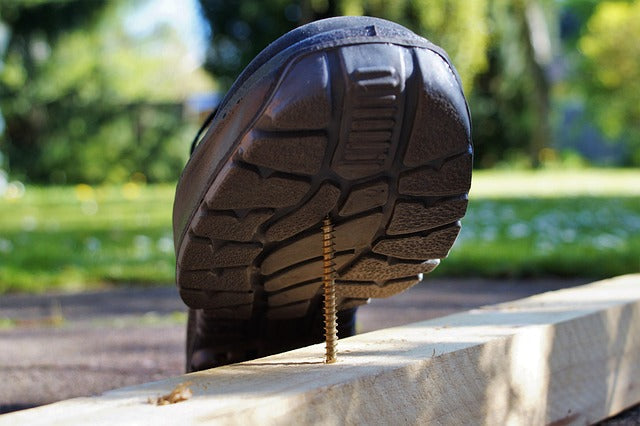
- Type P (Metallic insole, results in S1P, S3, S5, S7): Corrosion-resistant steel midsole, tested with a 4.5-millimetre diameter cone-shaped nail. Steel soles are very thin and insensitive to extremely sharp objects, but due to their design do not cover the outermost sole edge, are somewhat stiffer and conduct floor cold more strongly.
- Type PL (Non-metallic insole "Large", results in S1PL, S3L, S5L, S7L): Multilayer textile fibre or composite insole, tested with a 4.5-millimetre test nail. It is flexible, cold-insulating and covers the entire insole area up to the edge.
- Type PS (Non-metallic insole "Small", results in S1PS, S3S, S5S, S7S): High-density non-metallic insole, which is tested with a significantly thinner test nail of 3.0 millimetres diameter. It is recommended whenever thin nails, staples, wire ends or fine metal shavings may be on the floor in the company.
It is also worth looking at the material properties in the data sheet for toe caps and outsoles:
| Component and material | Advantages in company use | Limitations and special features |
|---|---|---|
| Cap: Steel or aluminium | Very low wall thickness enables a flat, compact shoe tip; aluminium saves around 30 to 40 percent weight compared to steel | Conducts heat and cold at extreme outdoor temperatures; triggers metal detectors at security gates |
| Cap: Plastic / composite material (Composite, fiberglass, carbon) | Low weight, thermally neutral (no cold bridge in winter), metal-free for airports and security gates | For the same 200 joules of test energy, a slightly larger material wall thickness in the toe area is required |
| Sole: Polyurethane (PU / two-layer PU) | Light, very good step cushioning for indoor floors, good cold insulation | Heat-resistant up to about 120 to 130 °C; subject to gradual ageing (hydrolysis) with incorrect storage over several years |
| Sole: Thermoplastic polyurethane (TPU) | High abrasion and cut resistance, very good slip resistance on smooth industrial floors, durable | Not designed for contact heat above 120 °C (no HRO suitability) |
| Sole: Nitrile rubber (Rubber / HRO) | Contact heat-resistant up to 300 °C (additional symbol HRO), very cut-resistant and resistant to many acids, alkalis, oils and fuels | Slightly higher self-weight than pure PU or TPU soles (therefore often combined with a soft PU midsole) |
Important additional markings from SR and ESD to SC and LG
If the basic combination of a protection class is not sufficient for special workplace hazards, the requirement profile is supplemented with standardised additional symbols:
- SR (Slip Resistance, additional slip resistance): Indicates shoes that have passed the more demanding slip test on a ceramic tile wetted with glycerin, in addition to the mandatory basic test (ceramic tile with cleaning agent). Indispensable in workshops, kitchens and areas with greasy floors.
- FO (Fuel Oil, fuel oil resistance): Confirms that the outsole does not swell or shrink when in contact with hydrocarbons (oils, petrol, diesel).
- ESD (Electrostatic Discharge according to DIN EN 61340-5-1): Protects sensitive electronic components from electrostatic discharge through a defined dissipation resistance between 105 and 3.5 × 10⁷ ohms.
- HI and CI (Heat / Cold Insulation): Heat insulation of the sole complex on hot floors (HI, tested at 150 °C) or cold insulation (CI, tested at -17 °C for winter construction and cold storage).
- SC (Scuff Cap, abrasion protection of the upper cap): Tested abrasion-resistant upper cap at the shoe tip; prevents the leather above the toe cap from wearing through during kneeling activities (e.g. in tiling, paving or assembly trades).
- LG (Ladder Grip, grip on ladders): Defined lug profile in the sole joint area for a secure stand on ladder rungs.
- AN and M (Ankle and instep protection): Additional impact protection at the foot ankles (AN) or over the instep (M).
How these abbreviations interact with the other PPE standards in the company can be read in our post Choosing PPE correctly: What lies behind categories and standards.
Fit, width systems and orthopaedic insoles according to DGUV Rule 112-191
A safety shoe cannot be "broken in" like a leisure shoe at the rigid toe cap. If the cap edge presses on the little toe or the heel floats in the shaft, blisters, poor posture and joint complaints occur. For procurement in the company, the DGUV Rule 112-191 "Use of foot and knee protection", updated in December 2025, recommends the following points:
- Shoe size and time of day of the fitting: During a working day, the human foot swells by several millimetres in length and circumference due to strain and heat. Fittings should therefore take place in the afternoon and always with the actual work socks worn in the company from the category Socks and accessories. Before the toes, a push allowance of around 10 to 15 millimetres must remain free under the cap.
- Use width systems: Since feet differ greatly in ball width for the same shoe length, brand manufacturers offer safety shoes in different widths (for example width 10 for narrow to normal feet, width 11 as a comfort width and width 12 for strong, wide feet) as well as on special women's and men's lasts.
- Strict rule for orthotic insoles and shoe fitting: Employees must never, on their own, place an arbitrary insole from a medical supply store or drugstore into their safety shoe. A thicker third-party insole raises the foot in the shoe, reduces the tested minimum clearance under the toe cap, and changes the electrical through-resistance (antistatic A or ESD). This immediately invalidates the EU type-examination certificate. According to DGUV Rule 112-191 and DIN EN ISO 20345 (Annex A), only insole systems tested and approved by the shoe manufacturer for the respective type-tested shoe may be used, and they must be fitted by a podiatrist strictly according to the manufacturer's instructions.
Our guide Occupational Health vs. Occupational Safety explains how the legal responsibilities of the employer, safety officer, and company doctor are regulated in such adjustments.
Care, storage and end-of-life: When must safety shoes be replaced?
There is no legally fixed wearing period in months for safety shoes; how long a pair lasts depends on mechanical, thermal, and chemical stress. To preserve their service life, damp shoes should be dried in a well-ventilated place at room temperature after the end of a shift (never directly on a heater, as this will make leather brittle) and regularly cleaned and cared for.
According to DGUV Rule 112-191 (December 2025 edition), the end of service life has been reached and the shoe must be replaced by the company immediately as soon as any of the following criteria apply:
- Impact damage to the toe cap or midsole: After a heavy blow to the cap or a nail penetration, the shoe must be removed from service immediately, even if hardly any damage is visible externally.
- Worn-out sole tread: If the tread depth in the main load areas is worn down to less than 1.5 to 2 millimeters or parts of the outsole are coming loose, the tested slip resistance is no longer guaranteed.
- Exposed cap or damaged upper: If the upper leather above the toe cap is worn through, seams are torn open, or the upper and sole are separating.
- Deformed heel cap or destroyed inner lining: If the shoe no longer provides stable heel support, the risk of ankle sprains increases.
- Aging of PU soles (hydrolysis): Even unworn shoes with polyurethane soles age in storage due to humidity. If the sole crumbles or cracks during visual and bending inspection before use, the shoe may no longer be issued.
Checklist: Procuring safety shoes for the company
- Risk assessment according to § 5 ArbSchG and DGUV Rule 112-191 (mechanical, wetness, slip hazard, heat/cold, ESD) documented for each work area
- Protection class (S1 to S7) and penetration protection type (P for steel, PL for a 4.5 mm nail, or PS for thin 3.0 mm objects) determined according to DIN EN ISO 20345:2024-06
- Required additional symbols checked (SR for smooth/oily floors, FO for fuels/oils, HRO for contact heat, SC for kneeling activities, ESD in electronics)
- Fit ensured through fitting with work socks, women's/men's lasts, and width adjustment systems
- If orthotic insoles are required, a system model tested for type approval according to DGUV Rule 112-191 has been selected
- Regular visual inspection of the sole tread, cap area, and end of service life incorporated into the instruction according to § 3 PSA-BV
At Technigro: Safety shoes for trades, construction, and industry
At Technigro, you will find safety shoes and occupational shoes in all protection classes according to DIN EN ISO 20345:2024-06 and DIN EN ISO 20347:2024-06 for warehouses, workshops, construction sites, and production facilities. Through the B2B program, companies can conveniently order their ongoing requirements via their own company account.
Note: This post provides general information (as of October 27, 2026) and does not replace safety advice. The required personal protective equipment and protection class are determined by your company's risk assessment. If in doubt, clarify the selection with your occupational safety specialist or company doctor.
Printable B2B Work Aid
Requirements profile, inspection sheet and checklist as PDF (8 pages)
Sources
- DIN EN ISO 20345:2024-06 (EN ISO 20345:2022+A1:2024): Personal protective equipment, safety shoes, as well as DIN EN ISO 20347:2024-06 (occupational shoes) and DIN EN 61340-5-1 (ESD), DIN (standard search). Edition checked, accessed on October 27, 2026.
- DGUV, Personal Protective Equipment Department (Foot Protection Area): Overview of abbreviations according to EN ISO 20345 and EN ISO 20347. Accessed on October 27, 2026.
- DGUV Rule 112-191: Use of foot and knee protection (new December 2025 edition, including work area recommendations, orthotic fitting, and end of service life), DGUV. Accessed on October 27, 2026.
- Regulation (EU) 2016/425 of the European Parliament and of the Council on personal protective equipment, EUR-Lex. Accessed on October 27, 2026.
- Federal Office of Justice: Occupational Health and Safety Act (ArbSchG, § 5) and Personal Protective Equipment Ordinance (PSA-BV, §§ 2 and 3). Accessed on October 27, 2026.