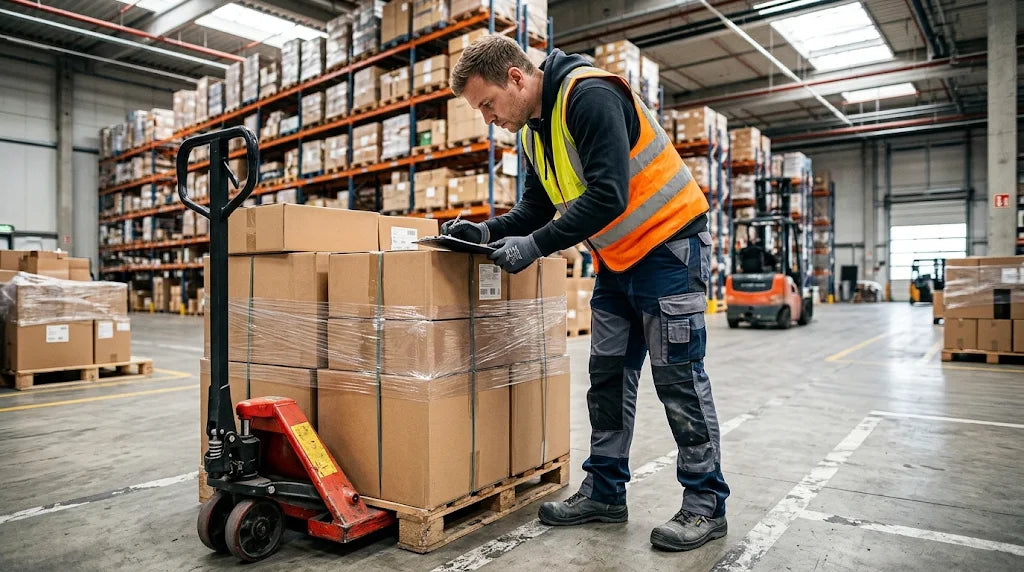



Safety Shoes S2: Protection in Wet Conditions According to EN ISO 20345
S2 safety shoes are designed for damp work environments, but they are not waterproof. According to the DGUV summary of short codes for DIN EN ISO 20345:2024-06, S2 corresponds to class S1 and is additionally tested for water penetration and water absorption. Basic features include a toe cap tested to withstand an impact of 200 joules, a closed heel area, antistatic properties, and energy absorption in the heel area. S2 belongs to classification I for shoes made of leather and other materials; fully formed rubber and polymer boots are classified as S4 and S5.
Our assessment: Splashes, cleaning water, and damp floors are typical environments for S2 shoes, but not standing water. For that, classes S6 and S7 are available, which additionally test the entire shoe for water resistance. The risk assessment determines which class your company needs.
Our range consists mainly of safety ankle boots, as well as boots for women and men and two pairs of sandals. The largest share is held by ELTEN, supplemented by COFRA, ABEBA, and runnex.
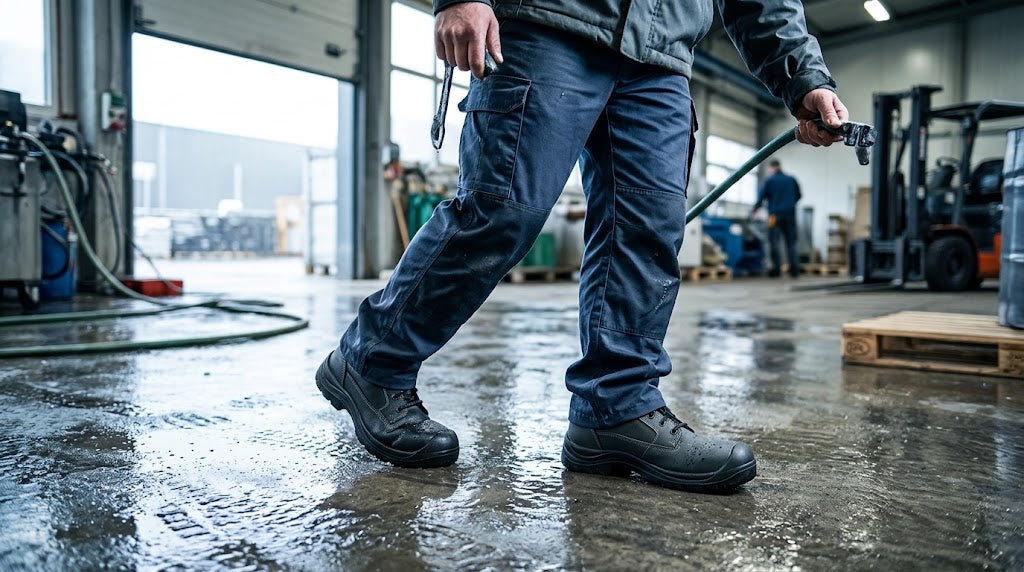
From damp to wet: Which class suits your conditions
Two questions determine the class: How long and how intensely is the shoe exposed to moisture, and what is on the floor? This classification is our interpretation based on the DGUV class definitions and does not replace the risk assessment:
- Occasional moisture, no sharp objects: S2, for example during cleaning work, in halls with mopped floors, or in hygiene areas
- Moisture and sharp objects on the floor: S3
- Permanently wet floors and puddles: waterproof shoes with WR, i.e., S6 (like S2) or S7 (like S3)
- Dry floor: S1, with sharp objects S1P
- Purely wet area: Wellington boots and waders
Even with occasional moisture, duration matters: The longer the contact, the more likely a waterproof shoe with WR will be worthwhile. Those working outdoors supplement foot protection with rain cover and weather and cold protection. Suitable ranges for Warehouse & Logistics and Production & Manufacturing can be found in the occupational groups.
How the standard tests water protection: WPA, WR and their limitations
For S2, the upper material is tested, not the finished shoe. The designation for this requirement is WPA (water penetration and water absorption) in the 2022 standard and WRU in the 2011 and 2012 standards. The test method is described in EN ISO 20344, currently DIN EN ISO 20344:2024-06.
According to the CTC testing laboratory, a half-cylindrical material sample is partially immersed in water and cyclically compressed to simulate the stress of walking. The time until water penetration, water absorption in percent, and the amount of water penetrated are measured. According to U-Power manufacturer specifications, the limits are a maximum of 30 percent water absorption and a maximum of 0.2 grams of water penetration.
The two tests differ in scope:
- WPA (S2, S3, S6, S7): Testing of the upper material for limited water absorption and low water penetration
- WR (S6, S7): Testing of the entire shoe in its assembled state for water resistance
This results in three limits. Our assessment: The material test says nothing about seams, the tongue, and the sole transition, it does not simulate continuous contact with standing water, and it does not replace slip resistance on wet floors.
What the new edition means for S2: DIN EN ISO 20345:2024-06 (EN ISO 20345:2022 + A1:2024) replaces the 2022-06 edition. Since 2022, the test has been called WPA instead of WRU, the waterproof classes S6 and S7 are new, and slip resistance is a basic requirement. Fuel resistance was still part of S1 to S3 in 2011 and has since been an additional symbol. According to DGUV, shoes according to the 2012 and 2022 standards are still on the market and in use.
Our guide S3 safety shoes: meaning, differences and use explains the classes S6 and S7 in comparison to S3, and Choosing the right PPE: What lies behind categories and standards provides an overview of categories and standards. You can find further designations in the PPE encyclopedia.

Checklist for purchasing S2 safety shoes
These points clarify things for companies before ordering and complement the risk assessment:
- Determine the level of wetness: Splash water and moisture are sufficient for S2, while standing water requires WR or S6 and S7.
- Check the marking: The standard, year of publication, and CE marking must be on the shoe. Older shoes carry the old markings.
- Clarify ESD requirements: In ESD-protected areas, the basic antistatic property is not sufficient; the additional ESD test is required (IEC 61340-5-1:2016). The majority of S2 models are designated as ESD shoes.
- Note the slip resistance: On wet floors, the sole counts. SR indicates an additional test with glycerin.
- Fit and target group: white models for hygiene areas, women's models such as LOTTE and Officer Lady, as well as models with BOA turn-dial closure for quick adjustment.
The size charts for Elten Shoes and Cofra Shoes provide guidance on sizing; you can find suitable socks and accessories in the shop.

Practical questions about S2 safety shoes
Do S2-safety shoes slip less on wet floors?
Do S2-safety shoes slip less on wet floors?
Not automatically. The water resistance of the upper says nothing about the slip resistance of the sole. According to the 2022 standard, slip testing on ceramic tiles with a sodium lauryl sulfate (NaLS) solution is a basic requirement for all safety shoes. The SR symbol indicates an additional test on ceramic tiles with glycerin. Therefore, when dealing with wet and dirty floors, it is worth looking for SR.
Are work shoes sufficient instead of S2 safety shoes?
Are work shoes sufficient instead of S2 safety shoes?
The risk assessment determines this. According to the DGUV subject area for foot protection, occupational shoes according to EN ISO 20347 do not need to have a toe cap, while safety shoes according to EN ISO 20345 are tested for an impact energy of 200 joules. If there is a risk of falling or striking objects at the workplace, occupational shoes are not sufficient. If there is no such risk, you will find occupational shoes in our range.
Can I wear S2 safety shoes with orthotic insoles?
Can I wear S2 safety shoes with orthotic insoles?
This depends on the model. According to the DGUV, shoe manufacturers provide information on whether and which insoles may be used. The DGUV also maintains a positive list for orthopedic foot protection. Clarify the use of the insole with the manufacturer before use to ensure that the certified protection is maintained.
How can I tell if a shoe has been tested according to the 2022 standard?
How can I tell if a shoe has been tested according to the 2022 standard?
On the year of issue of the standard in the marking and on the symbols. According to the manufacturers' overviews, SRA, SRB and SRC belong to the 2011 and 2012 standards, while SR, LG and SC only belong to the 2022 standard. S6 and S7 have also only been available since 2022. If in doubt, the manufacturer's product information is helpful, but the marking on the delivered pair is decisive.
Can I buy S2 safety shoes online?
Can I buy S2 safety shoes online?
Yes, S2 safety shoes can be selected online to find suitable footwear for your application.
When should S2 safety shoes be replaced?
When should S2 safety shoes be replaced?
If the toe cap is damaged or deformed, the sole is heavily worn or coming loose, the upper material is cracked, or the shoe no longer fits securely. Our assessment: A cracked upper material can no longer reliably ensure the tested water repellency. The binding criteria for when the footwear should be discarded are set out in DGUV Rule 112-191, December 2025 edition.
S2 or S3: Which safety shoe is right for you?
S2 or S3: Which safety shoe is right for you?
The deciding factor is whether objects can penetrate the sole at the workplace. S3 is based on S2 according to DIN EN ISO 20345:2024-06 and adds puncture resistance as well as a profiled outsole. Both classes are tested for water penetration and water absorption of the upper material; a shoe is only permanently waterproof with the additional WR marking. For damp indoor areas without nails, shards or splinters on the floor, S2 is often sufficient; on construction sites and outdoors, S3 is the usual choice. The decisive factor is your company's risk assessment.
Weiterführende Links und Quellen
Quellen
- DGUV, Fachbereich PSA: Welche Anforderungen beinhalten die Kurzzeichen?
- DGUV, Sachgebiet Fußschutz: Normen und Zehenschutzkappen
- DGUV: Häufig gestellte Fragen und Antworten zu Fußschutz
- DGUV Regel 112-191: Benutzung von Fuß- und Knieschutz, Ausgabe Dezember 2025
- DIN Media: DIN EN ISO 20345:2024-06, Sicherheitsschuhe
- DIN Media: DIN EN ISO 20344:2024-06, Prüfverfahren für Schuhe
- CTC: Water penetration and absorption (WPA), Prüfprinzip (Prüflabor)
- U-Power: EN ISO 20345:2022, WPA und WR (Herstellerinformation)
- Wenaas: EN ISO 20345:2022, Kategorien und ESD-Prüfung (Herstellerinformation)
- Safety Jogger: EN ISO 20345:2022, Rutschhemmung (Herstellerinformation)
- uvex: Kennzeichnungen EN ISO 20345:2022 (Herstellerinformation)
Abgerufen am 29.10.2026.
Hinweis: Diese Seite informiert allgemein (Stand 29.10.2026). Welche Schutzausrüstung erforderlich ist, ergibt sich aus der Gefährdungsbeurteilung Ihres Unternehmens. Im Zweifel klären Sie die Auswahl mit Ihrer Fachkraft für Arbeitssicherheit.