



Painting apparel for painters and varnishers: white, durable, well-thought-out
Anyone who paints, plasters, wallpapers or varnishes needs clothing with room for tools, freedom of movement on the ladder and padding for working on their knees. Traditionally, painters' clothing is white, and that is exactly how we offer most models in this collection. In addition to work trousers, overalls, shorts, jackets and shirts, you will also find genuine painters' trousers from the Painters series by Dassy with tool pockets and knee pad pockets, also in women's cuts for women. Further models are available from Engel, TRICORP, Schöffel PRO and HAKRO. Painters' clothing protects against paint and dirt, but it does not protect against solvents, paint mist and sanding dust. The employer determines what protective equipment is required in the risk assessment in accordance with the Hazardous Substances Ordinance. You can find the appropriate equipment under Respiratory Protection, Nitrile Gloves and Eye Protection. For interior woodworking, there is the Carpentry and Woodworking collection.

Pouches for putty knife, folding rule and brush
A good pair of painter's trousers replaces the tool belt. Holster pockets hold a putty knife, brush and utility knife, the tape measure pocket sits on the side of the leg, and the knee pad pockets hold knee pads for working on the floor and at the skirting board. Stretch content ensures freedom of movement on ladders and scaffolding. White clothing shows paint splashes clearly, which is why a fabric that withstands frequent washing is essential.
What to check before purchasing
- Holster and tape measure pockets on the correct side
- Knee pad pockets and matching knee pads
- Stretch content for ladders and scaffolding
- Washability according to the manufacturer's care label
- Waist trousers or bib and brace overalls, depending on preference and activity
Solvents, sanding dust and spray mist: protection by work step
Painter's trousers protect your clothes from paint, not your health from hazardous substances. The protection required for each work step is determined by the product's safety data sheet and the risk assessment. The BG BAU building blocks provide guidance for typical tasks:
- Solvent-based paints and stains: If ventilation is insufficient, respiratory protection with a Type A2 gas filter must be used. Gas filters of Type A are marked with the color brown and are tested according to DIN EN 14387.
- Spraying: Spraying also produces paint mist. For this, the BG BAU recommends combination filters A2P2 and protective suits of Type 5 and 6. Stricter requirements apply to isocyanate-containing paints; the safety data sheet provides guidance in this regard.
- Sanding: Respiratory protection must be worn when dust generation is clearly visible. Particle masks protect against dust, not against vapors.
- Skin contact: For thinners, paint strippers, and cleaners, chemical protective gloves according to EN ISO 374-1:2016+A1:2018 provide protection. Whether a material is suitable is indicated by the breakthrough time for the respective substance.
Technical measures such as low-solvent products, ventilation, and low-dust sanding equipment with extraction always take precedence according to the STOP principle. Respiratory protection and gloves are used when these measures are insufficient. Wear times and filter changes are based on the manufacturer's specifications and DGUV Rule 112-190 (Edition 11.2021). The employer bears the costs.
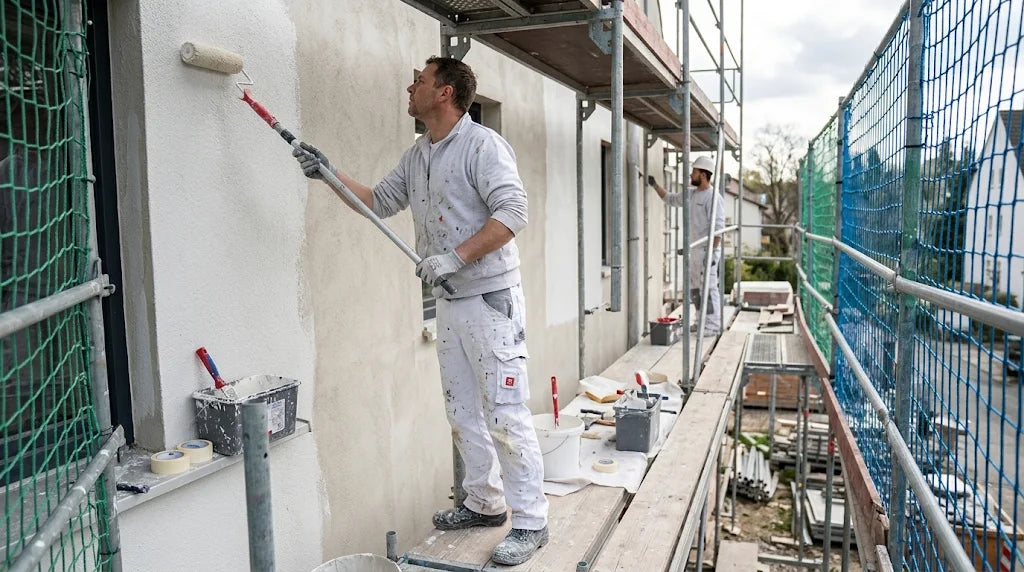
What your painting crew needs on the construction site
Interior work, facade work and painting require different things. These points should be included in the planning:
- Inside and out: For facade work in autumn, softshell clothing and a weather protection jacket complement the basic white outfit.
- Knees: Knee pad pockets are only useful with knee pads inserted.
- Feet: S1P safety shoes are common on construction sites. Work shoes without a toe cap are only an option if the risk assessment permits it.
- Skin: Skin protection before, skin cleansing during and skin care after work are essential at any workplace where paints and solvents are used.
We provide free on-site advice to companies in Berlin and Brandenburg, including on the right combination of painters' clothing and PPE.

FAQ: What Painters and Decorators Frequently Want to Know
Which respirator do I need for painting?
Which respirator do I need for painting?
For solvent-based paints, BG BAU recommends respiratory protection with a Type A2 gas filter if ventilation is insufficient. Spraying also produces paint mist, for which a combination A2P2 filter according to DIN EN 14387 is intended. You can find half masks and filters under Respiratory Protection and Filters and Accessories.
Is an FFP2 mask sufficient protection against solvent vapors?
Is an FFP2 mask sufficient protection against solvent vapors?
No. FFP2 masks according to EN 149:2001+A1:2009 filter particles such as grinding dust, but do not protect against gases and vapours. For that, you need a type A gas filter. The differences between the filter types are explained in the encyclopedia under Respiratory filters, and the FFP classes in the guide FFP2 or FFP3.
Which gloves are suitable for paints and thinners?
Which gloves are suitable for paints and thinners?
Chemical protective gloves according to EN ISO 374-1:2016+A1:2018. The breakthrough time for the respective substance is crucial; it is stated on the glove or in the safety data sheet. Many painters work with nitrile gloves, and the encyclopedia explains more about the classification under EN ISO 374.
What are knee pad pockets on painter pants useful for?
What are knee pad pockets on painter pants useful for?
The pockets alone provide little cushioning. Only knee pads inserted into the pockets, such as the Dassy Cratos knee pads, distribute pressure when working on the ground. Make sure that the knee pads and trousers are from the same manufacturer or are expressly designed to be compatible.
Do I need safety glasses when grinding and working overhead?
Do I need safety glasses when grinding and working overhead?
Eye protection is advisable when working with grinding dust, splashes, or overhead. Safety glasses are now tested according to DIN EN ISO 16321-1:2026-06, which replaces DIN EN 166:2002-04. Many models are still marked according to EN 166. Full-view goggles protect against splashes from all directions. The Safety Glasses Marking guide explains the markings.
Weiterführende Links und Quellen
Die Auswahl der Schutzausrüstung richtet sich nach der Gefährdungsbeurteilung Ihres Unternehmens.